
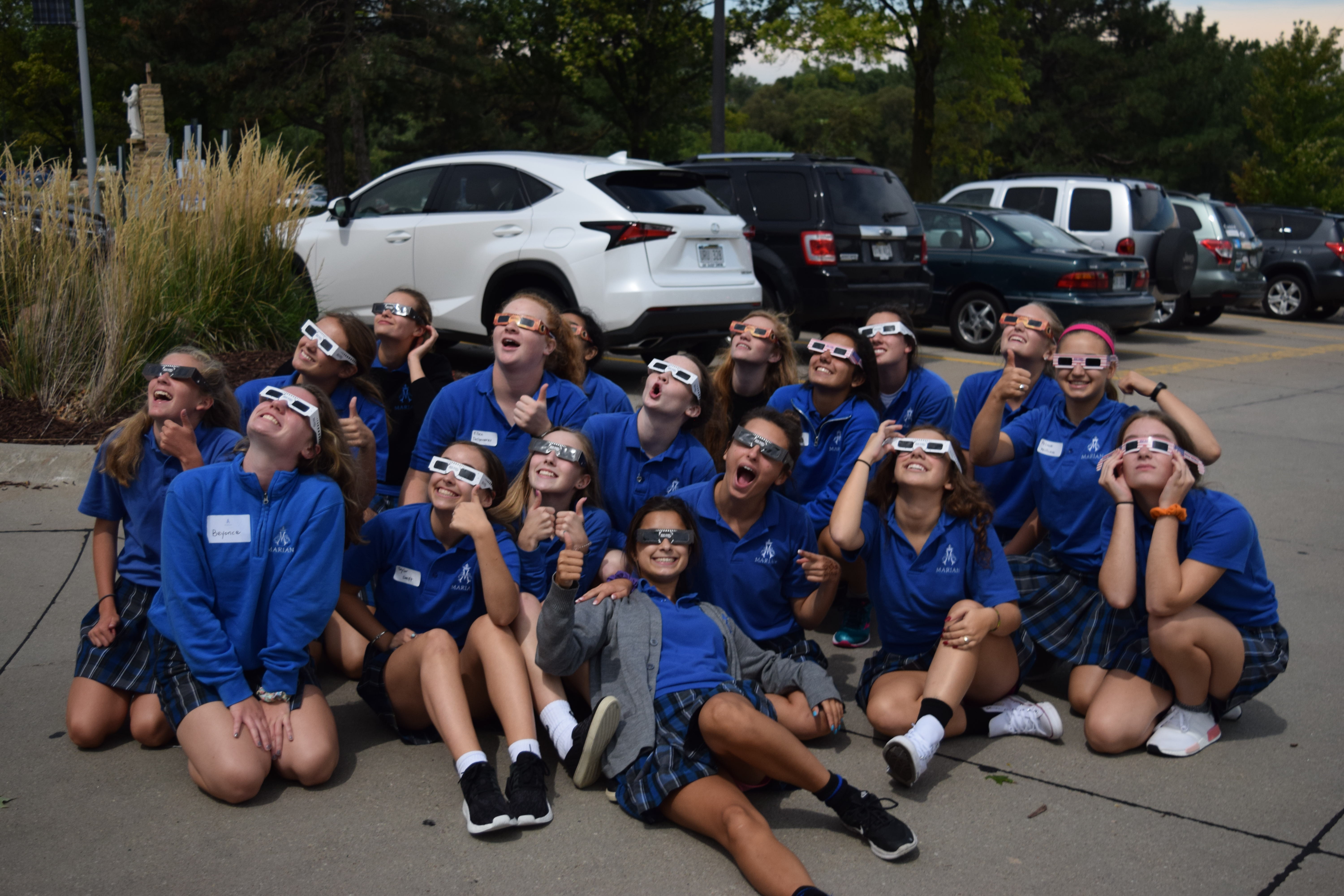
Science department chair, Dr. Sharon Genoways, organized a bus trip for mostly upper level science students to view the total eclipse of 2017 at the University of Nebraska at Kearney on Monday, Aug. 21. This was the first full day of the school’s academic year, and although it was a bit unconventional to have seven substitute teachers in the building on the first day, the science teachers and almost 140 students had an unforgettable experience.
 Those students who stayed back in Omaha witnessed a 98 percent eclipse, which was certainly interesting, but not as memorable as the view from the packed stadium in Kearney.
 The Omaha World Herald provided this graphic to explain the path of the total eclipse to its readers. According to its July 21 story, the last time a total eclipse was seen from somewhere in the contiguous United States was Feb. 26, 1979. According to eclipse wise.com, the last two total solar eclipses visible from Nebraska were on June 30, 1954 and Aug. 7, 1869. The next two total solar eclipses visible from Nebraska will be on May 3, 2106 and June 16, 2178.
During Block A on Aug. 21, students at Marian watched a video created by Dr. Genoways that explained the science behind the afternoon event. She explained why and when eclipse glasses were necessary. Students were then given glasses during homeroom.
Principal Susie Sullivan came on the PA at 12:45 p.m. and reminded students again of the safety precautions. If any glasses were scratched or damaged, those students were urged to get a new pair immediately from the main office. At 12:50, students were dismissed by floor to exit the building and stand in designated parking lots. At 1:10, students returned to class, with the partial eclipse visions captured in their memory. While a few students may have tried to sneak in a few phone photographs, the journalism students kept their cameras in the closet. Rumor had it that photos taken of the partial eclipse would damage the sensors in the SLR cameras unless they had been equipped with solar filters made especially for the event.
 A collection of the eclipse glasses was urged after the event to donate to school children in Asian and South America for the 2019 eclipse that will cross their path. The Papio-Missouri River Natural Resources Department collected the glasses for Astronomers Without Borders
More than 500 pairs of glasses were returned for this recycling/re-using opportunity.



Leave a Reply