
MaeveWharton
The Republic of Sudan is currently experiencing one of the largest humanitarian crises ever recorded. Around 150,000 people have died in the country’s current conflict and about 12 million have been forced to flee their homes in search of safety, according to BBC reporters on Nov. 3. Fighting erupted between warring military groups in April 2023, worsening already dire conditions created by decades of political instability.
Although this conflict is not heavily represented in western media, Social Studies teacher and former United Nations official Mrs. Katy Salzman said, “It’s really important for young people and all American citizens to be aware of what’s going on in the world.”
Citizens have a “responsibility to stay informed on current events” because “we elect the leaders that are going to be in positions of power to resolve these problems,” Salzman said.
When Salzman started teaching at Marian in 2016, another conflict occurring in Sudan was “declared by some humanitarian organizations as a genocide,” she said.
She noted that “today’s conflict can’t be divorced from decades of fighting in this area,” meaning that historical instability has only amplified the terror and destruction of the current conflict.
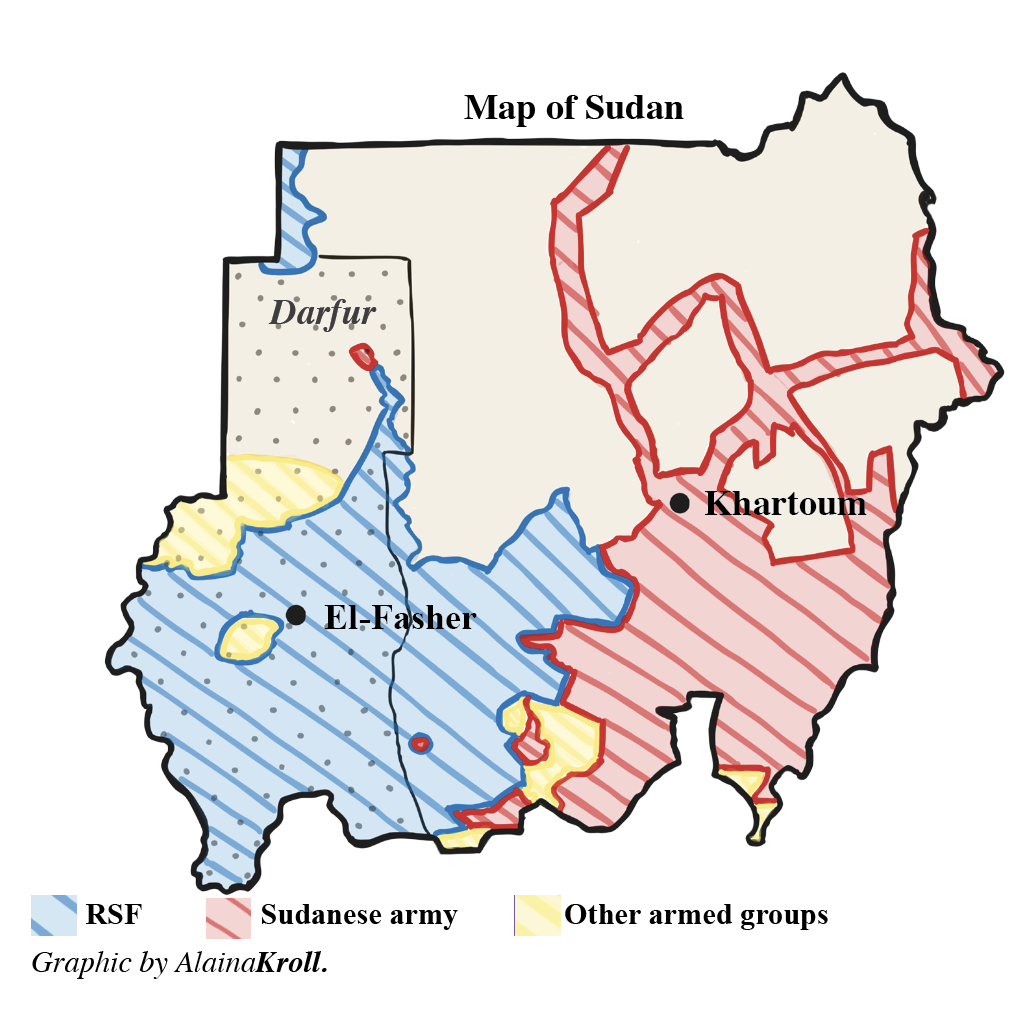
The current war is the result of tensions following the overthrowing of longtime President Omar al-Bashir in 2019. A subsequent joint military-civilian government was overthrown in October 2021. This coup was staged by two men, General Abdel Fattah al-Burhan, the current leader of Sudan, and General Mohamed Hamadan Dagalo, the current head of the Rapid Support Forces (RSF)—an armed group fighting against the country’s military, also known as a paramilitary. According to the BBC, disagreements arose between the two men on the country’s future, resulting in fighting between the 100,000-soldier RSF and the Sudanese army on April 15, 2023. The country is now effectively “divided in two,” according to Al Jazeera.

The RSF has historically been accused of genocide and ethnic cleansing against the non-Arab population in the region, which has contributed to the terror current civilians are experiencing.
United States intelligence has found that the United Arab Emirates (UAE) has been supporting the RSF, despite the UAE denying the claim. Conversely, Egypt has been accused of supporting the Sudanese army, said PBS News. Since both sides are allegedly backed by powerful nations, there seems to be no end in sight for the war.
On the ground, the Sudanese military currently controls much of northern and eastern Sudan. A city that has been particularly affected is the country’s capital, Khartoum. In March, the army freed the city from RSF control, which was described as a “burnt-out shell” by BBC reporter Barbara Plett Usher on April 1, 2025, with entire city blocks destroyed and burned.
Both of senior NuNu Gatpan’s parents are Sudanese immigrants. Although Gatpan has never visited the country, she shares her disappointment in its current state. Sudan was once a vibrant, beautiful country. “It used to be really pretty… this is not what it has always been,” she said.
In late October, the RSF gained control of the city of El-Fasher, a city in the region of Darfur. As reported on Nov. 5, by Rescue.org, an estimated 250,000 people remain inside either trapped, dead or facing severe risk should they attempt to leave the city. For 18 months, the RSF has destroyed the city, “causing hundreds of casualties, overwhelming hospitals and blocking food supplies,” wrote BBC reporters on Nov. 13.
Recently, the RSF began building “earthen walls” meant to trap city residents and block food distribution, only multiplying the devastation to the already food-deprived and suffering population of El-Fasher.
The capture of El-Fasher was a turning point in the war, entering a “new, dangerous phase” according to AP News reporter Sarah El Deeb on Oct. 29. The RSF now controls the entire Darfur region, raising fears that the country may split again, nearly 15 years after splitting from South Sudan because of a different civil war, according to AP News.
A UN investigation concluded that both the army and RSF have committed war crimes. However, the BBC reports that in January 2025, the U.S. concluded that the “RSF and allied militias have committed a genocide.”
As published by the U.S. Mission Geneva in a statement on Jan. 7, 2025, then-Secretary of State Anthony Blinken said “[The] RSF and allied militias have systematically murdered men and boys on an ethnic basis, and deliberately targeted women and girls from certain ethnic groups for rape and other forms of brutal sexual violence.” He sanctioned RSF leader General Dagalo, denouncing his actions as violations of international humanitarian law.
Throughout the country, citizens are suffering, starving and dying. Online, images of the horrors in El-Fasher are being broadcast to the world. The Yale School of Public Health has released satellite images confirming mass executions and mass killing sites within the city.
According to the UN Women Regional Director for East and Southern Africa, Anna Mutavati, “[women] have endured starvation.. displacement, rape and bombardment.” On Oct. 3, 2025, Public Information Officer for the UN Vibhu Mishra reported that around 89,000 civilians have fled the area, despite the risks the journey holds.
Famine conditions can be found in El-Fasher and many other cities in Sudan. As of early 2025, 24.6 million people are currently facing acute hunger, meaning they are near starvation, according to the Council on Foreign Relations. The city of El-Fasher remains cut off from food, medicine and humanitarian aid. Additionally, Rescue.org reports that “more than 70% of Sudan’s hospitals are destroyed, leaving millions without access to medical care” as diseases spread across the country.
In February 2025, President Trump announced an 83% cut to the U.S. Agency for International Development (USAID) programs, as reported by Council on Foreign Relations (CFR) reporter Mariel Ferragamo on April 14, 2025. This has the potential to be devastating for Sudan, as the United States contributed 44% of Sudan’s $1.8 billion humanitarian response through USAID in 2024. Muna Eltahir, a Sudanese humanitarian worker of more than 30 years, said “the USAID cuts have been the worst I’ve ever seen.”
“The plight of Sudanese civilians is going from bad to worse,” CFR Senior Fellow for African Policy Studies Michelle Gavin said. “There’s so much suffering,” Salzman said.
“In the end, there has to be a political solution,” Salzman said, which is complicated by continuously changing US administrations. However, she encourages students to write to their representatives. “It can be a very short letter … that brings attention to these representatives that somebody in their constituency thinks that [this] is an important issue.



Leave a Reply