
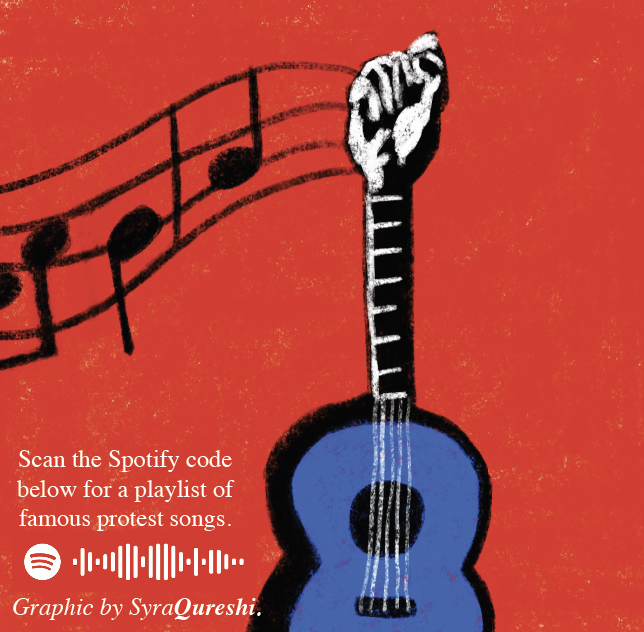
Opinion by SyraQureshi
John Lennon sings, “Imagine all the people living life in peace… you may say I’m a dreamer, but I’m not the only one.”
Yet, even dreams can become controversial when art takes a stance, aligning with one side or another. Suddenly, what resonates with some can separate others. We can all agree we want peace, yet art often carries messages that spark debate. So, should politics and art be separated, or is controversy simply part of creative expression?

In a time as political as 2025, it feels almost irresponsible for artists to stay silent. Music is not just a place for escape, it’s also a powerful outlet for protest, politics and change. Musicians have both the platform and the duty to speak for the marginalized.
To be honest, the idea that music should stay “neutral” feels almost ancient. Although some argue that politics can turn art into propaganda, it’s apparent that political music has fueled some of the most raw and relevant music, still holding true today.
Folk music was forged in political struggle. Released in 1940, Woody Guthrie’s “This Land is Your Land” celebrates the American landscape, yet was seen as radical for its time. It critiqued capitalism and was meant to challenge the idea that land belonged only to those who could afford it. This protest song is widely known and still sung at political rallies today because of its broad, adaptable message of patriotism, inclusion and protest.
Similarly, 1962’s “Blowin’ in the Wind” by folk artist Bob Dylan was an anthem for the Civil Rights Movement. It used rhetorical questions about peace, war and freedom to highlight social injustices and the human tendency to ignore them.
Songs like “Fortunate Son” by Credence Clearwater Revival, “Imagine” by John Lennon and “Redemption Song” by Bob Marley used rock and alternative styles to make powerful political statements. They addressed issues like war, inequality, oppression and violence, turning personal and national struggles into universal calls for justice and peace. Their melodies and lyrics made complex social critiques accessible, inspiring generations to question authority and push for change.
Yes, choosing to express political beliefs in your music is risky, and an artist might run the risk of audience conflict. But if your goal is to connect deeply and to be authentic, then shying away from hard truths can make your art feel hollow. Seeing how artists in the past made such an impact from their political anthems proves how just a song can impact generations. In an era where commercial success often pressures artists toward blandness, using pure passion can be a form of resistance and integrity.
These musical roots show us that art has not only reflected society but has shaped it. When artists lean into political expression, they echo that legacy and demand that listeners see the world for how it is.
In this decade, Kendrick Lamar’s “Alright” became a modern anthem of the Black Lives Matter movement. Through the genre of hip-hop, it spoke directly to systemic racism, police brutality and the resilience of the Black community. Its repeated message of survival and hope united people in protest and activism, showing how rap continues to be a vital platform for political expression today.
Audiences today now often expect something from artists. Once, artists were criticized for not taking a political stand, but in 2025, it seems like the norm. This expectation isn’t always fair but it underscores how much music matters again, not just as entertainment, but as commentary.
Political music and art are powerful because they tap into emotions in a way facts alone never can. When artists turn anger, hope or frustration into lyrics, it gives people a voice and a sense of unity, especially during cultural moments. A song can challenge authority and unite people in a way words can’t.
Ultimately, the question isn’t whether politics belongs in music, it’s how we let it in. When done with sincerity, politics in music isn’t just propaganda or sides, it’s truth. Music reflects real life and real life is political.
Whether one argues that politics does or does not matter in art, it’s obvious that political art makes a change. When artists turn anger, confusion and hope into sound, it doesn’t divide people, but it reminds us we’re all living through the same moment.


Leave a Reply