
 makenziefuss
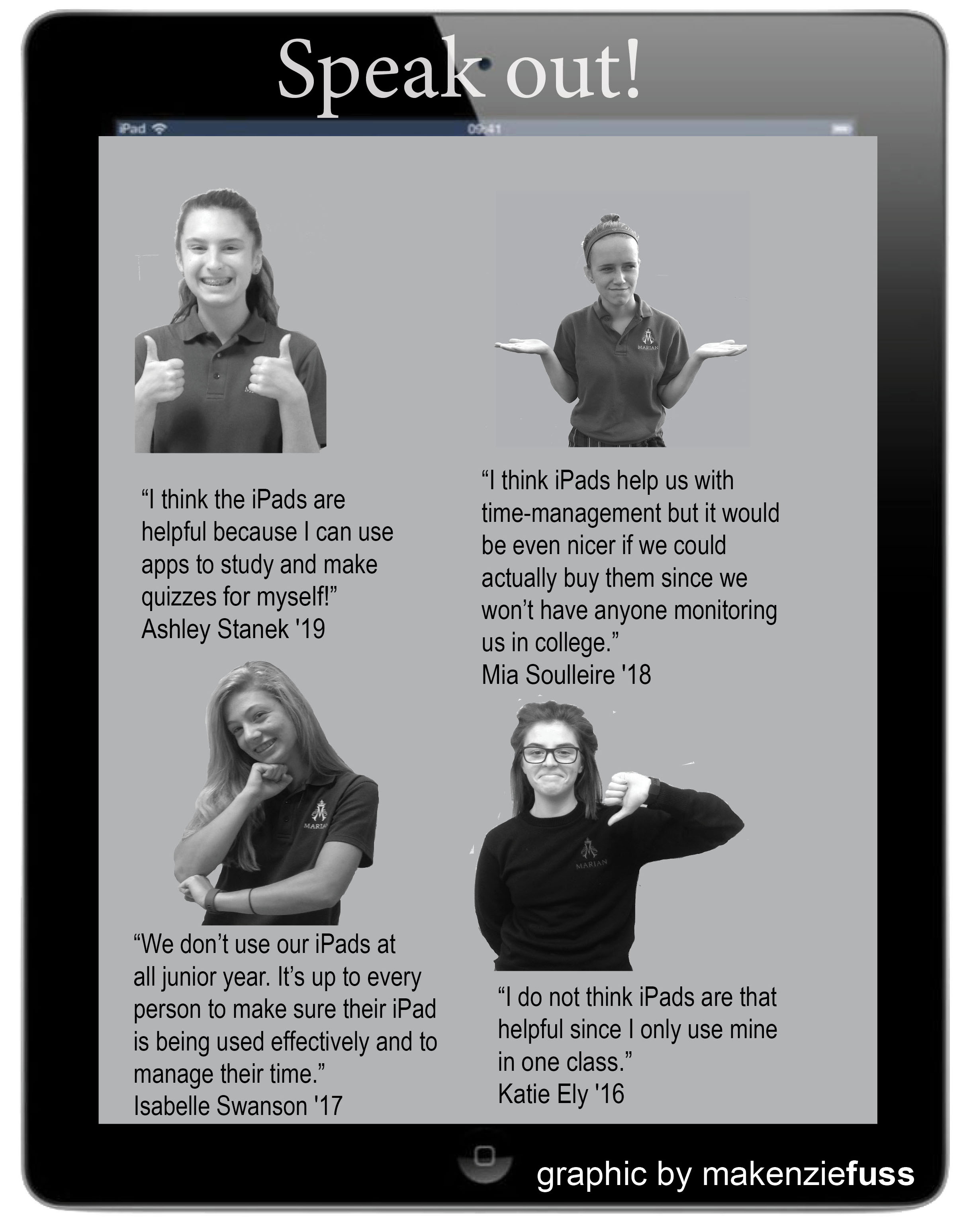
During their time at Marian, parents and students have asked at least once, “Are the mandatory iPads really worth it?” Seniors are the only class left who have seen Marian pre-one-to-one-technology, but how much has really changed in relation to having iPads in the classroom?
When it comes down to the facts, 67.7 percent of students who answered The Network’s survey said they prefer reading print novels to digital novels. Also, 83 percent have only one to three textbooks, and 5.4 percent don’t have any at all. Whether personal preference or otherwise, having so few textbooks on iPads raises the question: why do we have them in the first place?
Admittedly, iPads make things almost too easy. If a student splurges to get a keyboard, note taking is a breeze. Typing notes allows students to write, or even record, parts of teachers’ lectures, as well as take notes.
“I use eBackpack at least once or twice a week. I like how I can put handouts online in addition to giving out the hard copy,” social studies teacher Mrs. Amy McLeay said. This works especially well when someone who wasn’t in class can still get the homework. Also, when working on projects, it is easy to save your progress and work from any device at school or home.
However, this practicality does not come without a price. The technology fee at Marian is $350 per year. The fee goes toward the salaries of our 2-person technology staff, the computer lab that is available to all students as well as the Wi-Fi in the building that supports more than 1,000 devices in the building. This fee also covers Applecare, the iPad case, and the iPad itself. Despite that fee and the money spent buying online books, 63.8 percent of students still spend $150 or more on print textbooks. Almost 33 percent of those said they exceed the $250 mark.
At Marian, iPads are most commonly used for papers, projects, and apps such as eBackpack, an online “backpack” that holds assignments and handouts for classes. Some students say that the iPad is as good as a laptop when it comes to note taking, but many others think that the iPad fails to deliver. “I never use my iPad anymore: none of my classes use eBackpack. I haven’t touched my iPad since the second day of school,” senior Taylor Nihsen said.
The monetary cost of iPads is significant, as is the educational cost. iPads can prove to be a distraction, especially when students play games in class. Notes can accidentally get deleted from note-taking apps. Aside from all of that, what is the mental cost of using iPads instead of print books and hand-written notes?
“Books on iPads may be harder to read, but both have advantages. It depends on each person’s individual brain. If it is hard for someone to comprehend text with all the distractions, they need to get a book,” reading specialist and student success coordinator Mrs. Jennifer Christen said.
Ferris Jabr, a writer for the Scientific American in New York, wrote “Why the Brain Prefers Paper” that presents several different types of studies on how books on digital devices prevent people from efficiently reading long texts, subtly hurting one’s reading comprehension. This poses a serious problem when textbooks, novels, and notes are on iPads.
Having iPads in the classroom can have some setbacks, as the Marian community has seen over the last few years. However, as the times change it must be expected that the school and the student impact will change with it.
Marian students and staff are still learning all of the quirks and issues with iPads. Some have fully embraced the technology and others are still struggling. The administration is reviewing IPAD training and usage throughout this year due to feedback from the AdvancED surveys.
When it comes to the tech-saavy world, who knows what’s next on the technology to-do list.



Leave a Reply