
SophiaReinhardt
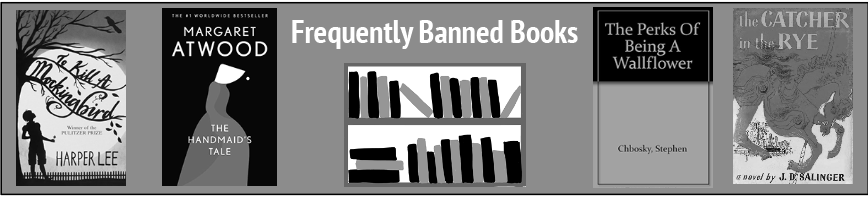
Banning books is nothing new. Oct. 1 through Oct. 7 was national Banned Books Week. During this week, people take a stand against banning books and spread information about books that have been banned in different countries, as well as different states. Some popular books that have been banned include “To Kill a Mockingbird” by Harper Lee, “The Perks of Being a Wallflower” by Stephen Chbosky and even literature like Margaret Atwood’s “The Handmaid’s Tale.”
Most of these books are on the banned list in schools or libraries due to their “controversial” messages. These can include content inappropriate for a certain age group, content with offensive language or content that expresses disrespect for parents or family.
As of now, there are states producing bills that ban books with content that is deemed “controversial” from libraries or from being taught in school. This is becoming a social and even a political problem.
More recently, teachers and students alike have been challenging book bans for censorship. People have noticed that banned books seem to be silencing certain groups of people. Although the people behind the book bans claim it’s under good intentions, many question what the real intentions of these book bans are. Can they be for good reason? Or is it just causing harm to today’s society?
Ms. Susie Sisson, head of the English department and English teacher, believes that books are being banned because of fear-based reasons. “People are afraid of what they don’t understand,” Sisson said. When people are afraid of things, naturally they want them gone.

There is a theory in literature that states that books can be mirrors or windows. You can read them and, like looking through a window, see outside into other people’s worlds, get new perspectives and even learn something new. Books can also be mirrors. You can read a book and see yourself or your own world where you can be stuck in your own bubble.
Book bans have all been orchestrated by adults. “Historically, groups of parents have been upset about content or language used in books,” Sisson said. Content of books has been the biggest debate since book banning began. What some parents deem appropriate for their children, others do not.
“Parents have a right to monitor the books they let their children read, but they do not have the right to prevent others from reading what they want to read,” she said.
Sisson talked of her own experiences with books and why she finds them so important to have access to: “I read everything, books changed my life,” Sisson said. They provide her with new perspectives and allow her to find out more about the world. “Why would you ever want to deny someone that experience?” Sisson asks.
Sisson thinks that books are being banned over other forms of media because “books are more associated with school and held to a higher standard.” She believes parents are concerned about how accessible books are.
The biggest recommendation Sisson has is for people to educate themselves and to pay attention to what’s going on around them. Sisson encourages everyone to “read whatever you want, [and to] read widely.”
Sophomore Katherine Dietz also believes that book bans are harmful, especially to the younger generation. “Book bans do so much harm to people our age because they prevent us from hearing stories of people who typically don’t have their stories told,” Dietz said. There’s concern of stories of people’s challenges or backgrounds not getting shared like they should be.
Young people, as mentioned before, are the ones who face the targeting of book bans significantly more than adults do. Book banning is aimed more at the younger generation because “they’re typically aimed at novels and enforced in schools,” Dietz said. Most of the adults who are banning books are trying to prevent the information from the books being spread to any children, who could then share it with others.
It is becoming more important than ever to unite and fight against these bans. “Students can talk to their parents about bans to see if there is anything they can do to get them lifted,” Dietz said. Most school boards have public meetings that students could attend to also find out more information. “We can also just read those books anyway,” Dietz said.
As of now, Banned Books Week is officially recognized and there are movements that aim to unite and fight against book bans. Sharing any and all information about banned books helps, and spreading awareness about these book topics is one of the biggest steps one can take to stand up and help end the banning of books.
Read a related story from the Flatware Free Press!



Leave a Reply