
Spotlighting an elective in the context of interdisciplinary learning
MarthaEngel
Make friends. Do math.
Room 111’s whiteboard is full of unique math quotes, added throughout the year with reminders to remember parentheses, jokes and math equations. Each Block A, the History of Math class discusses readings, annotates books, solves problems and has conversations about math and history while writing on the same whiteboard.
The inaugural Honors History of Mathematics course is winding down their first semester. This class is a prime example of interdisciplinary learning, the intersection of multiple subjects to learn more about the world in a different way. The integration of multiple academic areas helps students see what they’re learning as part of a bigger picture, whether it’s art and science or English and computer engineering.
Students in the History of Math class not only learn about historical events and important people, but they also learn new kinds of math and understand the role of women in mathematics. Math teacher Miss Megan Han said, “It’s an assortment of history topics as well as mathematical topics, starting from the very ancient mathematicians and very early uses of mathematics,” allowing students to explore centuries of math and history. While Han normally teaches subjects such as algebra, geometry, and pre-calculus, she is able to bring in new types of math and explore aspects of math history in this elective.

“There’s just so much information and knowledge here that most people don’t know about,” Han said, and high school history classes don’t often cover advancements in mathematics. Beyond this, “We’re looking at various different mathematical topics that you wouldn’t normally see in a high school curriculum,” Han said, ranging from modular arithmetic to Euler Circuits. “It’s something that I find really interesting,” Han said, and her enthusiasm extends to her students.
Junior Lucy Ambrose said, “I love the passion that people in this class have for learning,” whether it’s tackling new equations or presenting slides about mathematicians. Each Block A, “We all work and push each other since it’s a small class,” Ambrose said.
Junior Evelyn Bullock agreed: “I love how small the class is and how much fun it is,” she said, referencing the many projects and discussions, for the six juniors and seniors who were able to add the course this fall.


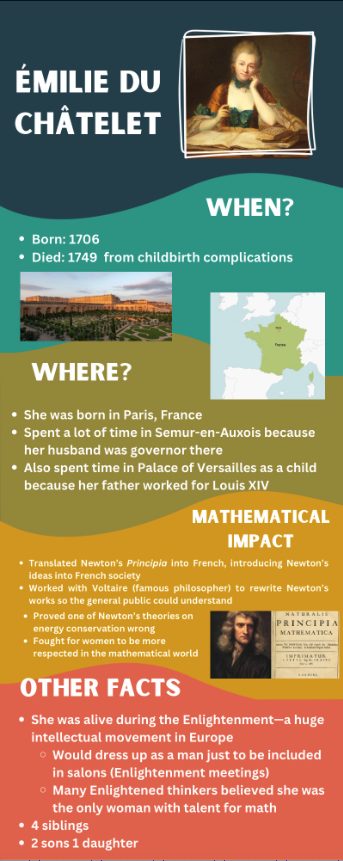
Almost every week, students receive an infographic assignment.
This assignment requires students to explore a mathematician, researching their life, work, historical context and fun facts. These infographic assignments serve multiple purposes: students learn about new mathematicians and important historical figures, gain presentation skills, and help build a database of mathematicians.
Beyond this, the class had a number of guest speakers, from mathematician and professor Ellen Veomett to Marian alumna and computer engineering major Katie Tiojanco ’20. These speakers provided another perspective on math in the world, from geography to coding languages and more. This class focuses on connections between mathematics and the world, whether it’s the past or present.
Han said, “If math is something that’s exciting to you, I would definitely think about this as an opportunity to look at math in a different way,” more than the average algebra class. However, “if math is not your favorite thing, but you really like reading and history, give this a chance. It might help you see math in a different light,” Han said. By catering to multiple areas of interest and different strengths, extracurriculars allow students to explore.
As this is the first year of Honors History of Mathematics, the future is unknown for the course. While it will not be offered during second semester, depending on interest and registration, this class will be available during the fall of 2024.
There’s always something truly interesting to learn. When students are able to make connections between different areas of interest, such as History and Math, they’re able to gain a comprehensive education across all of their classes. And that, Han said, “shows [everyone] that there is room for lots of interest in different topics.”




Leave a Reply