
MariellaVirgillito
As the world ushers in the Chinese New Year, or Spring Festival, it marks the beginning of the Year of the Dragon. This majestic creature is a symbol of strength, wisdom and good fortune. The animal represents the Chinese zodiac, promising a year of new beginnings and exciting possibilities.
“Typically when we think of New Year celebrations we think of how we celebrate in the U.S. It’s the start of a new year, January 1. With Spring Festival, it typically occurs in February. This year it’s February 10. A lot of times, in east Asian cultures, they use zodiac signs to indicate the start of a new beginning. It’s a seasonal long celebration versus a one day celebration,” Director of Belonging, Diversity and Inclusion Ms. Ty Nared said.

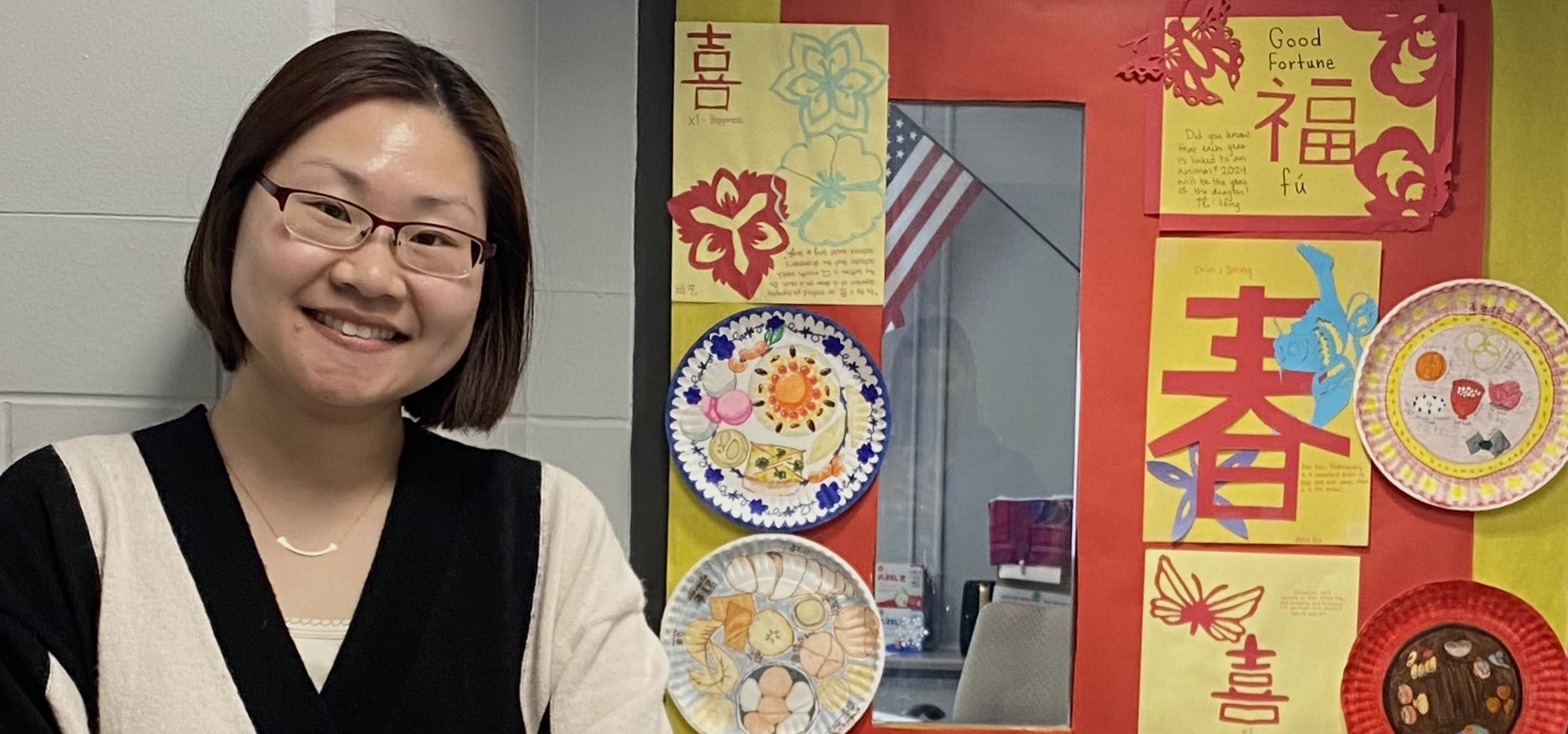
Mandarin teacher Mrs. Sicong Mills poses outside of her classroom. The door is decorated with each of her classes’ projects for the Spring Festival. Photo by MadisonShaffar.
Spring Festival celebrations began with the traditions of the Chinese, or luni-solar, calendar which was initially used to tell farmers about the arrival of spring. The festivities following the beginning of a new year developed into what is known as the Chinese New Year.
However, as many east Asian countries have also adopted the Chinese New Year celebrations, the proper term is Spring Festival. Though many people refer to the celebrations as the Lunar New Year, that is not the correct term because the Lunar Calendar is for Muslim tradition, explained Mandarin teacher Mrs. Sicong (Emma) Mills.
Communities around the globe are preparing for exciting celebrations, embracing the unique energy that the Year of the Dragon brings. This mythical creature is believed to bring about transformation, success and prosperity.
The Dragon, a legendary figure in Chinese culture, is revered for its power and grace. Those born under this sign are said to inherit qualities such as ambition, charisma and resilience. As the dragon soars, it leaves behind a trail of inspiration for individuals to pursue their dreams with determination.
The Spring Festival celebrations, spanning 15 days, include traditions that weave together the past, present and future. Streets come alive with the vibrant hues of red and gold, symbolizing luck and wealth. Families gather for feasts that carry symbolic meanings of good fortune and abundance.
There are many students and faculty who celebrate Spring Festival, and it has been a part of their tradition their entire lives. “I was born into the tradition of the New Year since I come from a Vietnamese family. In Vietnam, we call the New Year Tết,” junior Elizabeth Nguyen said.
“One of my favorite traditions is getting money in red envelopes from my family and getting to wear my traditional Vietnamese dress known as an áo dài,” Nguyen said.

Junior Elizabeth Nguyen celebrates the Spring Festival. She enjoys receiving red envelopes and wearing red for luck. Photo courtesy of Nguyen.
Mills also shared her New Year traditions growing up in China. “For about five days [my family and I] would travel back and forth from the city to the country to celebrate and visit with family and friends,” Mills said. “We also had carnivals and light festivals in the streets of the city. While I was in the country with my grandparents, my cousins and I would go around the village to visit relatives and neighbors door-to-door to wish them ‘Happy New Year.’ We would spend the whole day getting candies, food, and chatting with them,” Mills said.
“When I was a kid, the red envelopes and my new outfits from my mom were my favorite parts,” Mills said.
Amidst the festivities, the dragon dance takes center stage. Its movements ignite a spirit of unity and hope. Fireworks are shown in the night sky, warding off evil spirits and inviting in a year of positivity and joy.
In the spirit of the dragon, communities come together to honor their heritage, share laughter and strengthen bonds. Elders share wisdom, and younger generations carry forth the traditions, creating a bridge between the past and the future.
“[Spring Festival] is the most important [celebration] of the year for Chinese people. From the time I remember, my family would get together for the New Year, and there would often be a rich dinner and some special food such as rice cakes,” sophomore Jingxin (Luna) Zheng said.
Zheng lived in China her entire life before moving to the U.S. her freshman year for high school. Today, her favorite ways to celebrate the New Year are “eating dumplings, receiving red envelopes, setting off fireworks, cleaning and hanging lanterns,” Zheng said.
“Some ingredients are difficult to buy in the United States, so we usually choose hot pot, which is more convenient and suitable for a multi-person dinner,” Zheng said.
There are also many ways for people who don’t typically celebrate Spring Festival to learn more about the festivities. “I love to send out information about different cultural celebrations via email. Read the emails, pay attention to the Marian Diversity Instagram where we put out new music, different foods you can try to experience someone else’s culture,” Nared said.
“I also think people don’t really leverage social media as a search engine. One of the things that I like to do outside of other research is going to social media to see how content creators share about their culture. Using food to experience different cultures through taste is very beneficial,” Nared said.
As the world collectively steps into the Year of the Dragon, there is a shared optimism that transcends borders. The dragon’s mythical presence serves as a reminder to embrace change, pursue ambitions and forge a path toward a brighter future.
So, let the dragons ignite a flame of hope and possibility while celebrating the Year of the Dragon with open hearts and a sense of wonder.




Leave a Reply