
Staff editorial
Media advertisement has been around since the 1600s. What first started as newspaper ads evolved into catchy jingles and now, in this day and age, has turned into Instagram posts and “day in the life” vlogs.

It’s no surprise that companies have started to use social media as their main form of advertising because it is cheaper than traditional forms of advertising and can often reach a bigger audience.
But we believe social media advertisement has gone too far and it seems like all of the media we consume is now an ad, even if we do not know it.
Influencers are constantly pushing new products to their followers. Every “day in the life” starts with Bloom nutrition and the influencers swear by it, but are they paid to say they like it or do they truly like it?
We understand that influencers have to support themselves somehow and paid partnerships are part of that. However, what is frustrating is that there is limited transparency on which of the posts are ads or are actually genuine.
Social media and influencers are not the only ones who are overusing advertisements, as movies are too.
In the new movie “Anyone But You,” there were many scenes that were obvious advertisements. When Bea, who is played by Sydney Sweeney, is on the plane, she holds up a bag of Smart Pop. In another scene, her bag by Miu Miu, which Sweeney is a brand ambassador for, is so perfectly placed in the camera that it is hard not to realize it’s a promotion.
“Barbie” also had an influx of ads throughout its two hours. It’s no surprise Mattel advertised its products throughout the movie, but other brands were so shamelessly plugged that it became hard to watch. For example, what felt like a 10-minute segment was completely dedicated to promoting the Chevy Blazer. We all thought it was an intermission and a commercial had begun, but nope, the movie was still going.
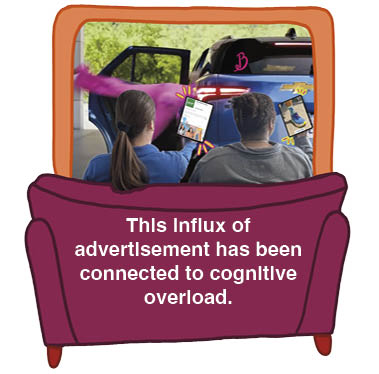
This influx of advertisement has been connected to the cognitive overload people have because of social media.
According to the Medical College of Wisconsin, “Cognitive overload occurs when the combination of intrinsic, extraneous and germane loads becomes overwhelming for the learner.”
Brands take advantage of this cognitive overload because, after scrolling for long periods of time, people are more likely to buy products because their brains cannot fully comprehend what they are being presented.
It’s no surprise that Instagram and TikTok seem to have the most ads because they also are the most media-rich platforms, thus making people more likely to buy products because they have gone into cognitive overload.
If we all became more mindful of the time we spend scrolling, then maybe brands would tone it down on the marketing.



Leave a Reply