
Abby McGuire

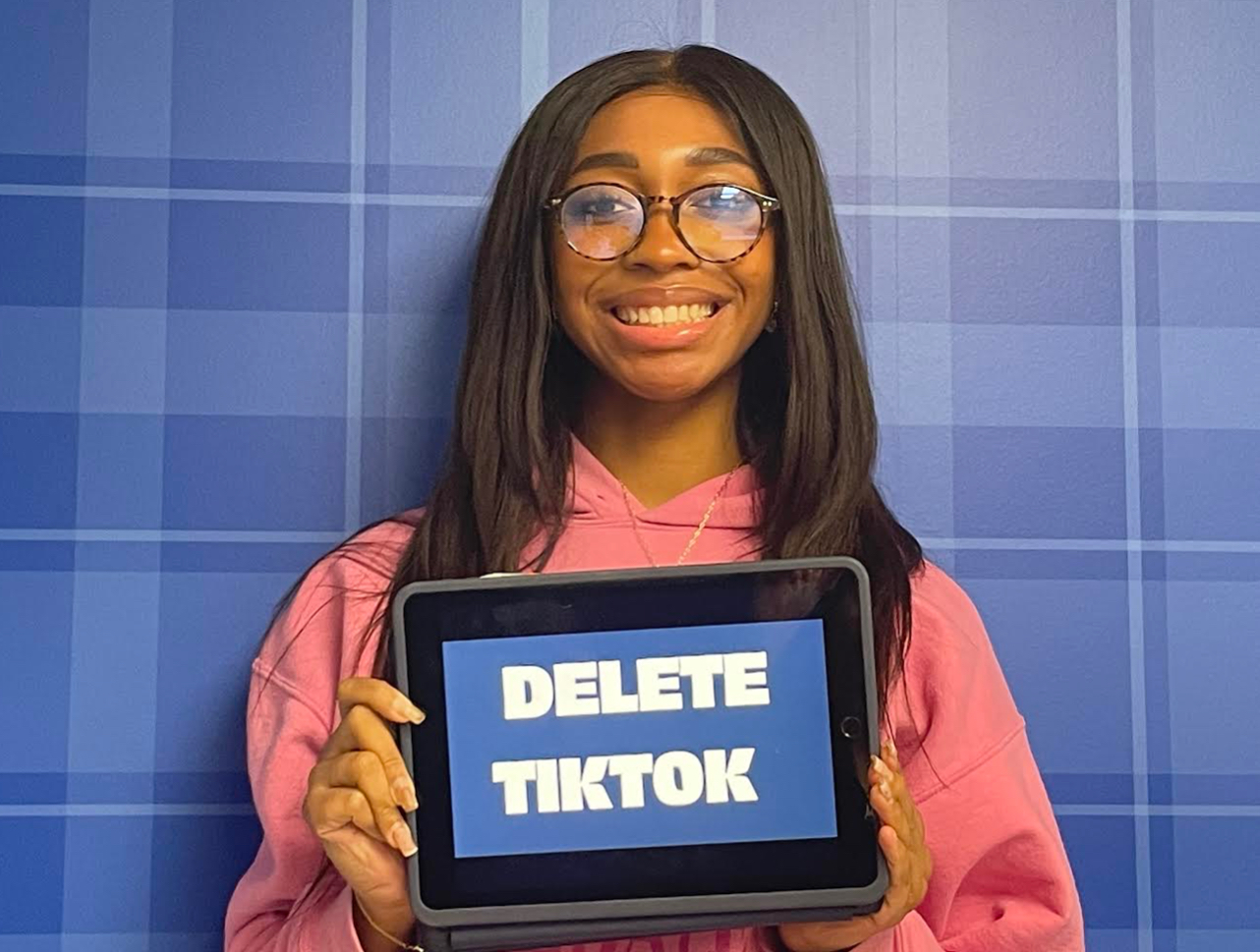
Caroline McDonald ‘25 poses with a sign urging students to delete tiktok
When most Marian girls log in to their phones every morning, there is one app they flock to: TikTok. However, junior Caroline McDonald wanted to challenge these chronic online tendencies.
So, as a personal challenge, she decided to delete TikTok for a few weeks and compare her behavior to when she had it. She has yet to redownload it and doesn’t think she will in the future. “I see a lot of harmful things that come with TikTok. I might redownload it during the summer, but as of right now, I like not having it,” McDonald said.
For bored high school students bent on procrastination, social media seems like an easy escape. You can simply open your phone and tap into an app that sends you constant dopamine hits. McDonald sees this as a major problem, “because of short video platform apps, our patience and attention spans are a lot shorter. These 30-second videos are now more popular than the 10-minute long vlogs that we used to love and cherish on YouTube. Now TikTok gives us an instant gratification and dopamine rush because we get to consume so many different things at once.” Social media worsens mental health for students across the board, because it leads to constant comparison and increases insecurities.
McDonald has struggled with this, personally, “Along with platforms like social media, there is a hierarchy that places certain people at the top of trends, sounds and hashtags. There is also a problem with the trends that are immersive from TikTok. There are a lot of trends that are about your nose profile, your side profile, and many other things.These trends to beauty standards are unbreakable because they are recurring,” McDonald said.
This puts pressure on teenage girls to look a certain way, and if they don’t fit the trends, or are constantly aesthetic, they feel they are seen as less worthy. These trends enforce a narrative that is impossible to fulfill. They are not only expensive, but they are a time sink.
Despite her criticism, McDonald does see the upside to having TikTok and being active on various social media platforms. “I think social media is a great place for advocacy and education. During the BLM protests in 2020, there was more education than ever about other civil rights movements. This is the positive side of education, where we aren’t praising people for their beauty, but rather uplifting others and supporting our differences,” McDonald said.
Social media is an amazing way to stay connected with your friends and gain larger education on social issues. It is a good platform for social movements, like BLM, that wouldn’t have been able to gain as much traction without social media outlets.
However, this is only a small win, in comparison to all the mental health struggles and procrastination social media brings. Deleting TikTok not only helped McDonald disrupt several of her harmful patterns in relation to social media, but it also helped her to focus more on herself and her friends, while decreasing her stress level. Dropping TikTok isn’t as scary as it may seem, and if you make the choice to break up with the algorithm, there’s a good chance you will be better on the other side.




Leave a Reply