
AbbyMcGuire

Alzheimer’s is a terminal form of dementia. Besides being hard to identify in its early stages, it slowly incapacitates the affected and not only distorts but causes them to forget their memories.
Alzheimer’s is currently the seventh leading cause of death in the United States and is more common in women than in men. According to Medical News Today, by 2060, 13.9 million people in the United States are predicted to be suffering from Alzheimer’s disease.
It also impacts the Marian community. Freshman Charlotte Dugger said that she recently lost her great grandmother on her dad’s side of the family. “The last time she remembered me was in 4th grade. It hurt really bad to watch everyone grieve when she didn’t even remember the last years of her life.”
Freshman Lily Foix and her family are dealing with her grandfather’s dementia. Through tears, she said, “It’s hard seeing someone you know wither away. I didn’t realize how much it affected me and my family. He’s not to the point of not remembering us, but he forgets to take his meds and sometimes forgets how to walk.”
Currently, there is no cure. Although there are ways to improve the life of someone with Alzheimer’s, like blood pressure medications, comfortable living conditions and physical therapy, there isn’t a pill or treatment method that slows the disease progression.
The non-existence of a miracle pill is a multifaceted issue, and there’s still debate within the medical community about where to even start. According to the American Association of Retired Persons, most Alzheimer’s drugs fail during testing and never go farther than a lab room. The human brain is so resistant to drug penetration that the mechanics of getting the drug into the brain is almost harder than creating a drug itself. Even if this miracle pill was created, it would only be treating a physical symptom, and the root of the disease would still exist.
These facts cause a lack of hope in the general population, leading to lower funding rates for researchers. The Alzheimer’s Association is a non-profit organization working to end the social perception of Alzheimer’s, and instead direct people to what the future could look like with continued research. They also want to bring awareness to how to interact with Alzheimer’s patients and help families find resources for their afflicted relatives.
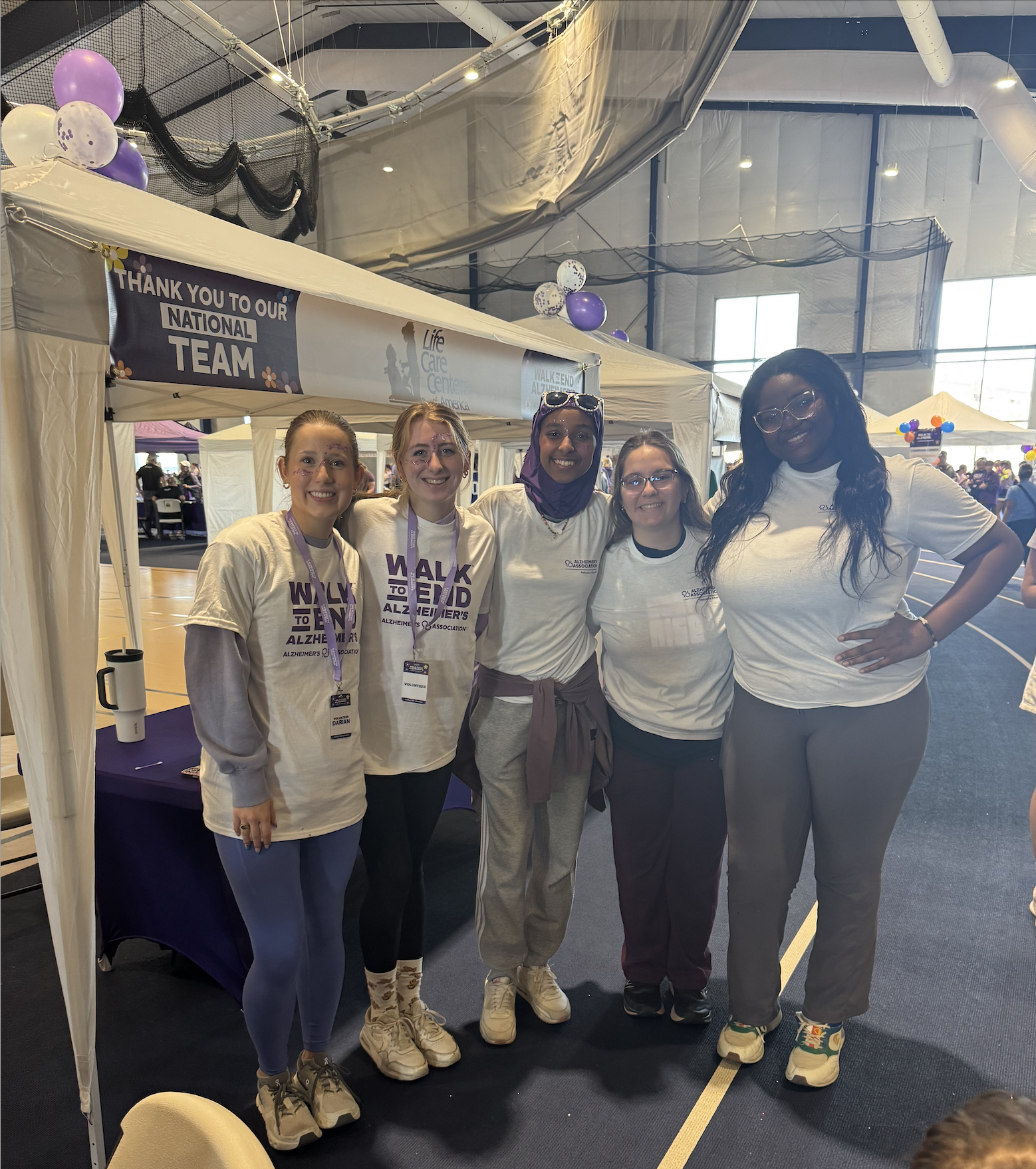
One of the events they host to raise awareness is here in Omaha and is aptly named the Alzheimer’s Association Walk to End Alzheimer’s. It took place Oct. 13 at the College of Saint Mary Flames Fieldhouse. Several Marian students, including juniors Shrada Mamilla, Isabella Valencia Valbuena, Lauren Camp and seniors Kaylene Bialas, Olivia Camerer, Dominika Kouassi and Sarah Mohammad are involved with the Alzheimer’s Association Youth Advisory Board. Bialas, Kouassi and Mohammad helped out at the booth.
“At the walk I did face glitter, temporary tattoos with sponges and passed out ‘End Alzheimers’ bracelets,” Mohammad said.
The walk was a large event with multiple speakers and booths, “Usually the walk consists of different booths advocating for different organizations. Moreover, there are speakers who talk about the purpose of the walk and the importance of advocating for Alzheimer’s. Individuals can walk and talk with others while supporting Alzheimer’s,” Mamilla said.
Mamilla is the Student Leader of the Alzheimer’s Association Youth Advisory Council. The youth council focuses on raising awareness in the Omaha community through advocating and fundraising.
“I believe youth should get more involved with the fight to stop Alzheimer’s and be aware of the impact Alzheimer’s has on us human beings. Youth can do a lot in advocating, fundraising and spreading awareness to all. If Marian girls are interested in helping out please join the Alzheimer’s Association Youth Advisory Council. Please reach out to sshinkel@alz.org!” Mamilla said.
Bialas agreed, “…it [Alzhiemer’s] affects the lives of so many people.”
Raising awareness of Alzheimer’s will help raise funding and opportunities to find a cure.




Leave a Reply