
CoventryThompson
Indigenous Heritage Month, celebrated every November, serves as a way to celebrate and remind Americans of Indigenous culture, history and issues. Even though Indigenous Americans may be small in number, their culture and communities have a profound impact on students.
Junior Lea Fals grew up around Indigenous culture and its rich history in San Diego. “[Indigenous culture] was highly celebrated in my school and where I lived, so I always thought of it as something a lot of people knew a lot about. When I moved here, I realized people still thought of Native cultures as ‘primitive’ which annoyed me,” Fals said.
Fals also wishes that more Americans viewed Indigenous culture as more relevant and modern rather than a relic of a primitive past. “[Indigenous People’s] gender roles and the way they lived their lives were different from European culture, but they were still relevant and interesting,” Fals said.
Fals not only has familial connections to Indigenous culture, but she also used to live near an Indigenous historical site. On the site, there were “historical buildings that were domed and made of mud, hay and sticks. Inside, they had tools that the Native Americans used to grind corn and acorns for food,” Fals said.
Freshman Maeve McGill also draws inspiration from Indigenous culture, largely through her family’s close friendship with Fr. Dave Korth, who used to work as a pastor for the St. Augustine Indian Mission.
“While he was working with this mission, we went to one of the powwows organized by the Winnebago and Omaha tribes of Nebraska. At the powwow, there were Indigenous vendors selling clothes, jewelry and other artisan goods. During the powwow, there was a large dance performed by people of all ages from the tribes,” McGill said.
Even though she was only 6 years old when she attended the powwow, McGill remembers how kind and welcoming the Indigenous community in Winnebago was. “They welcomed us with open arms, and they even taught my sister how to do one of their traditional dances,” McGill said.
McGill also has vibrant memories of the dancers at the powwow. “The dancers wore these very vibrant clothes with feathers and beaded elements. Some of the dancers had metal cones attached to their attire, which made the dancers’ clothes make noise along with the dancers’ movements,” McGill said.
Like Fals, McGill also said she believes that many Americans misunderstand Indigenous culture. “I want more Americans to know that Indigenous people are not very different from the rest of the world in the fact that everyone has certain cultural traditions and lifestyles and theirs may be different than ours, but other than that they are very similar to us,” McGill said.
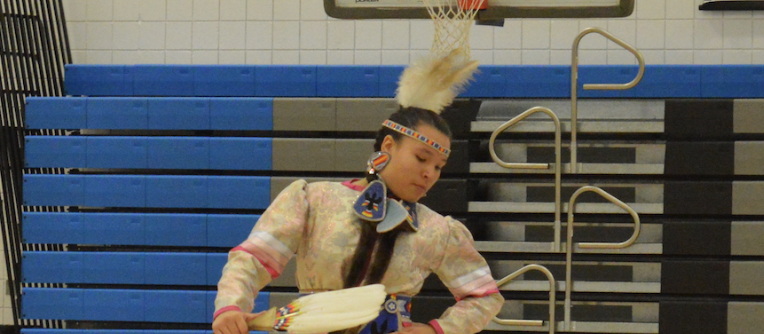
The Washkon Foundation provided a learning experience for students through an assembly celebrating Indigenous Heritage Month on Nov. 21. The assembly started with a land acknowledgment from Mrs. Ty Nared and the Diversity Board. The presentation featured four main dances: the Men’s Traditional, the Women’s Traditional, the Old Style Jingle Dance, and the Grass Dance.
The first dance, the Men’s Traditional, was performed by Gabriel Barea who is part of the Omaha tribe; he wore traditional regalia which featured a bustle and roach of eagle feathers. Repetitive drum beats played in the background of all the dances; the beats symbolize the heartbeat of the people.

The Women’s Traditional dance was performed by Christina Wedner. She has Diné and Ioway heritage. She has a strong connection to her dancing as she views it as a way to spiritually represent those who cannot dance. She also makes strong connections between the Women’s Traditional dance and feminine power; the steps taken during the dance are small yet capable as they are meant to be close to Mother Earth.
Naomi Ike and Eva Grant, who are also members of the Omaha Tribe, performed the Old Style Jingle Dance. The two young women wore traditional regalia which featured jingles traditionally made from tobacco can lids.
Naomi’s brother, Ross, performed the Grass Dance. The dance served as a way to pat down grass and create flat grounds to place a tribal meeting venue or a new arena for ceremony. The dance is traditionally done by young men.
The CAB ended with an inter-tribal dance which was performed by all of the dancers. The drummers played the traveling song in the background as the dance went on and as students slowly left the East Gym.

To learn more about Indigenous culture, dances, and powwows, attend the 14th Annual Wambli Sapa Memorial Powwow on April 19, 2025. The powwow’s theme is “We are Urban: from Reservation to City.” The event will commemorate the Indian Relocation Act of 1956, a policy that aimed to encourage Indigenous Americans to assimilate into urban society by encouraging relocation from reservations to cities.
The theme will highlight the journey of Indigenous cultures from reservations to cities and the stories of families and individuals who have striven to maintain a strong connection to their ancestral lands.




Leave a Reply