
AbbyMcGuire
In a city like Omaha, where Irish history is engraved into the cobblestone, it’s not rare to catch a glimpse of the elusive Irish dancer.
The Irish dancing art form has deep roots in Irish and Celtic history, and it can be traced all the way back to ancient Celtic times, where they would do pagan dances to worship the sun gods. Fast forward to the 1600s, where Irish dancing has evolved from pagan ritual dances to the classic pub jig. Skipping ahead to the 1920s, the Gaelic Dancing league was created to recover Irish history that was lost to British imperialism.
Today, this dancing serves as a way for people to reconnect with their culture. It is unique for its focus on hops, stomps, kicks and very little usage of the arms and hands, and is commonly featured at pageants and cultural festivals.
Sophomore Brigid McFall is no stranger to the dance floor, and has dabbled in Irish dancing throughout her performing arts career. She jumped into the activity during 2020 as a way for her to utilize a creative outlet during the pandemic and form new friendships in the midst of isolation.

She joined it specifically to reconnect with her culture and experience a type of dance that is very different from other styles, “…there’s a lot of like, I don’t know if I’d call it pageantry, but they are a lot more into the competitions, where it’s based on skill but it’s also based on your costuming and how you present yourself. And then the posture is a really cool thing, because you never use your arms really…sometimes if you’re doing a show, you could do arm choreography, but it’s all in the legs because you’re standing straight up.”
Although she no longer participates in Irish dance in order to pursue other Marian activities, she is forever grateful for the friends she made. “I love the community in itself. But then also, being Irish, I really felt in tune to my culture and I feel like I learned a lot, and met a lot of people who had Irish heritage.”
Irish dance is more than just practicing in a studio, it is a true community and McFall was able to experience much more of Omaha’s Irish cultural opportunities as a result of joining.
“I’ve done dance in the past, but doing Irish dancing, it really opened doors to different events that I get to go to. So every Saint Patrick’s Day we went to every Irish place ever, it was almost kind of like a cultural shock.”
Saint Patrick’s Day is the stereotypical holiday associated with Irish culture- and it is a big day for the Irish dance community as well. They are expected to go all out and perform for festivals. These specific performances help to continue the preservation of Irish culture in the Midwest, and they are commonly associated with Irish culture.
McFall has participated in these St. Patty’s day celebrations herself, and it is one of her favorite memories of her Irish dancing experience, “…we go to competitions all across the country, but I always went to the Kansas City ones, and they have an Irish fest. And they have a competition during the Irish fest. So every day after competition, the whole team would go to the Irish festival together, and they had fun things like silent disco and all these different food trucks that we got to go to together. So it was a lot of fun to go with the whole team.”
These team bonding activities solidified her friendships with people on the team, and gave her the opportunity to experience Irish culture in another city. These experiences help to tie all Irish communities together and people look forward to them all year. In order to give the festival goers a proper show, McFall would have to practice several dances, but she had a favorite.
“It’s called a treble jig, and it’s a hard shoe [tap shoe] number…and it’s usually a bit faster than the other dances,” said McFall.
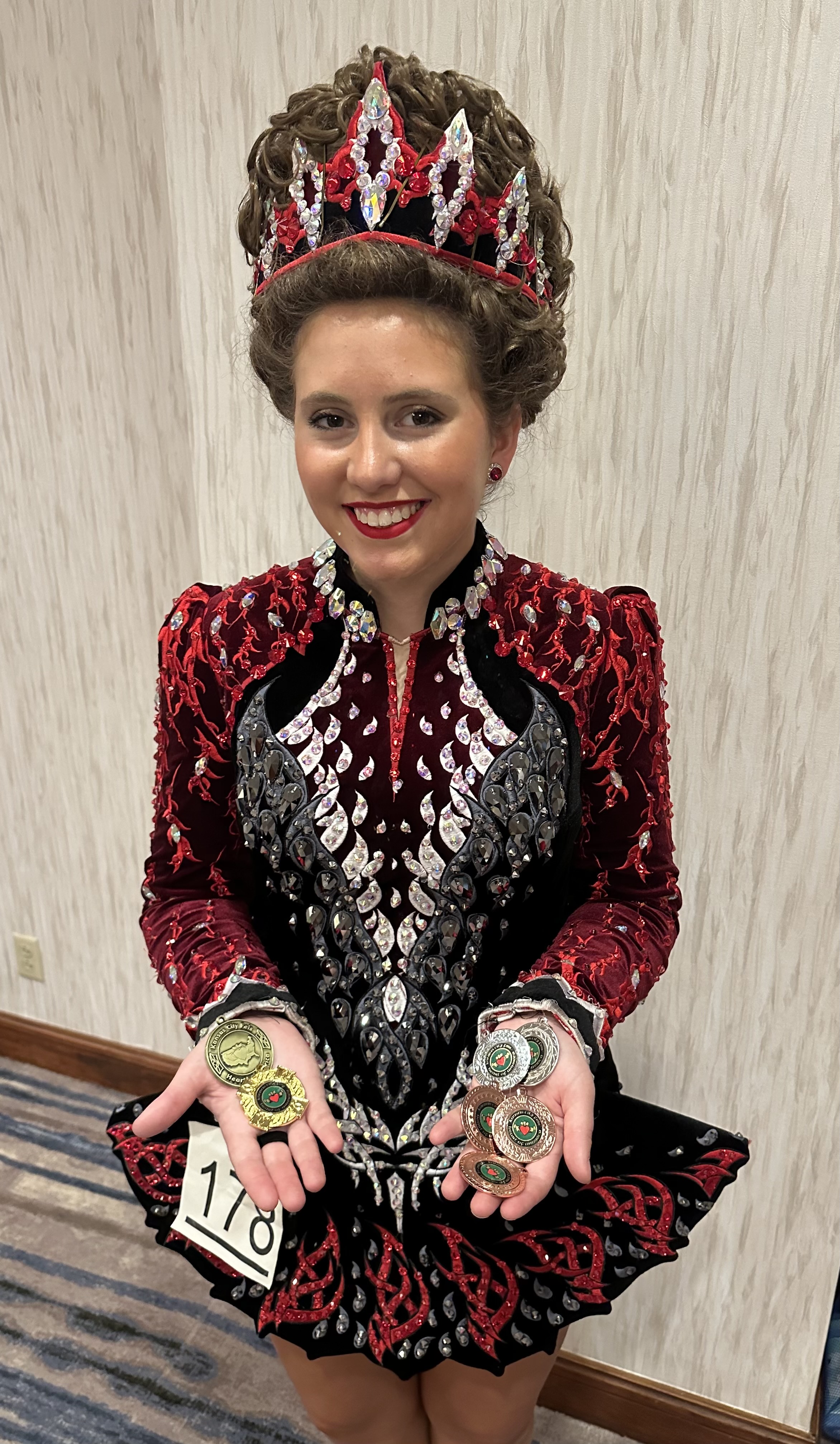
One of the signature parts of Irish dancing is the tap shoes. They create a rhythm for the dancers and provide a music element to the dancer’s performance. Even more than the tap shoes, the wigs and dresses are icons of Irish dancing.
“We’ve always had the curly hair, and they switch to wigs because it’s easier to do that than to do your own head of curls…with the costumes…every different Irish dance school has a school skirt…and everyone gets one of those skirts,” McFall said.
She continues, “So when you start out, you’re just in a school skirt and a black leotard. But then as you go through the levels and the ranks of Irish dancing, you can work your way up to get a solo dress, which are those big, sparkly, expensive, velvet dresses you see…once you reach a certain level, they allow you to get your solo dress. Sometimes you get to custom make yours. I got mine made, so it has the St. Brigid cross on the back and I got to choose the colors and the design.”
Through the act of creating their own dresses, Irish dancing becomes a way to showcase individuality, personal creativity and connection to Irish culture. These dances exist as a way to reconnect with the past—and as they grow more modern, it means that Irish culture is still preserving and growing in America. Just remember—Saint Patrick’s Day isn’t the only day that Irish culture is relevant. Irish dancers have competitions all year long.

Leave a Reply