
By Alena Kehm

In recent years, a conversation about college athletics would be incomplete without the mention of NIL.
Starting in July 2021, the NCAA declared that college athletes can participate in activities in which they are paid for the use of their name, image, and likeness (NIL). These rule changes also permitted athletic departments to share revenue with their student athletes. Since then, all aspects of college athletics have changed.
College athletes now have the opportunity to collaborate with brands for sponsorships and make money off of the merchandise that is sold by their universities. This extra money can help prepare the athletes for life after college and help support them during their time as a student-athlete. Marian graduate and current Division 1 student-athlete Amanda Loschen said that she thinks NIL is “a positive way for student athletes to earn extra money, as most do not have time for jobs.”
Another Marian alum and current Creighton University soccer player Mallory Connealy has had experience with NIL during her career in college athletics. “I’ve received some NIL money, probably under $500 in total,” Connealy said. She advises, “you get…what you put in, meaning if you don’t reach out to businesses, build your platform, and actively search for NIL opportunities then you won’t find a lot of success.”
The effects of possible NIL money have also trickled down into the recruiting process. High-level athletes are beginning to consider how they will be financially impacted by their commitment decisions. “[NIL] has been abused recently as high profile athletes are recovering thousands of dollars for…committing to a certain team,” said Amanda Loschen. Once athletes are in college, NIL can be used as an incentive for transfers. In Loschen’s experience “[NIL] has made the transfer portal way more crazy and chaotic, leaving athletes without a school or in a worse situation than they were before.”
For committed athletes at Marian, most stayed focused on what their school had to offer as a whole, before considering the prospect of NIL money. “I feel like I chose Drake based on the soccer program,” said senior Kamryn Wray, who committed to Drake University in February. “The scholarships they had and the money they had was a factor, but the bigger factor was the…program, the location of the school, [and] how big the school was…rather than money.”
Some sports are impacted more than others when it comes to NIL. According to senior Meredith Peyton, her commitment to the University of Nebraska-Lincoln wasn’t affected by NIL because “swimming is not a big money sport for the school.”
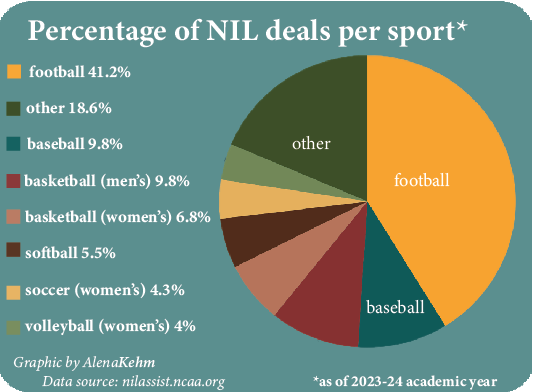
The phenomenon Peyton describes where “money-making” sports receive more NIL money and opportunities is common throughout the NCAA. Nil-ncaa.com compiled data from 20 power-conference schools. This data revealed that swim teams average around 0.1% of athletic department revenue sharing, while football teams average 75%. “I don’t think that it’s fair…but it’s the reality of college athletics,” Loschen said. “The teams that bring in more money are going to get more revenue dollars to create NIL opportunities.”
These types of NIL discrepancies also exist between men’s and women’s teams. Out of the 20 power conference schools surveyed, the men’s basketball teams receive an average of 16% of the allotted athletic department NIL revenue, while women’s basketball teams acquire a mere 1.1%.
When Marian commits look toward their futures in college athletics, these disparities will be something they are forced to consider. “I think it’s kind of disappointing that women’s sports come second even if they have a more successful program” Wray said.
Although these disparities exist, NIL is intended to be beneficial for athletes. Learning to navigate both the positives, and negatives of NIL will continue to be crucial part of college athletics in the years to come.




Leave a Reply