
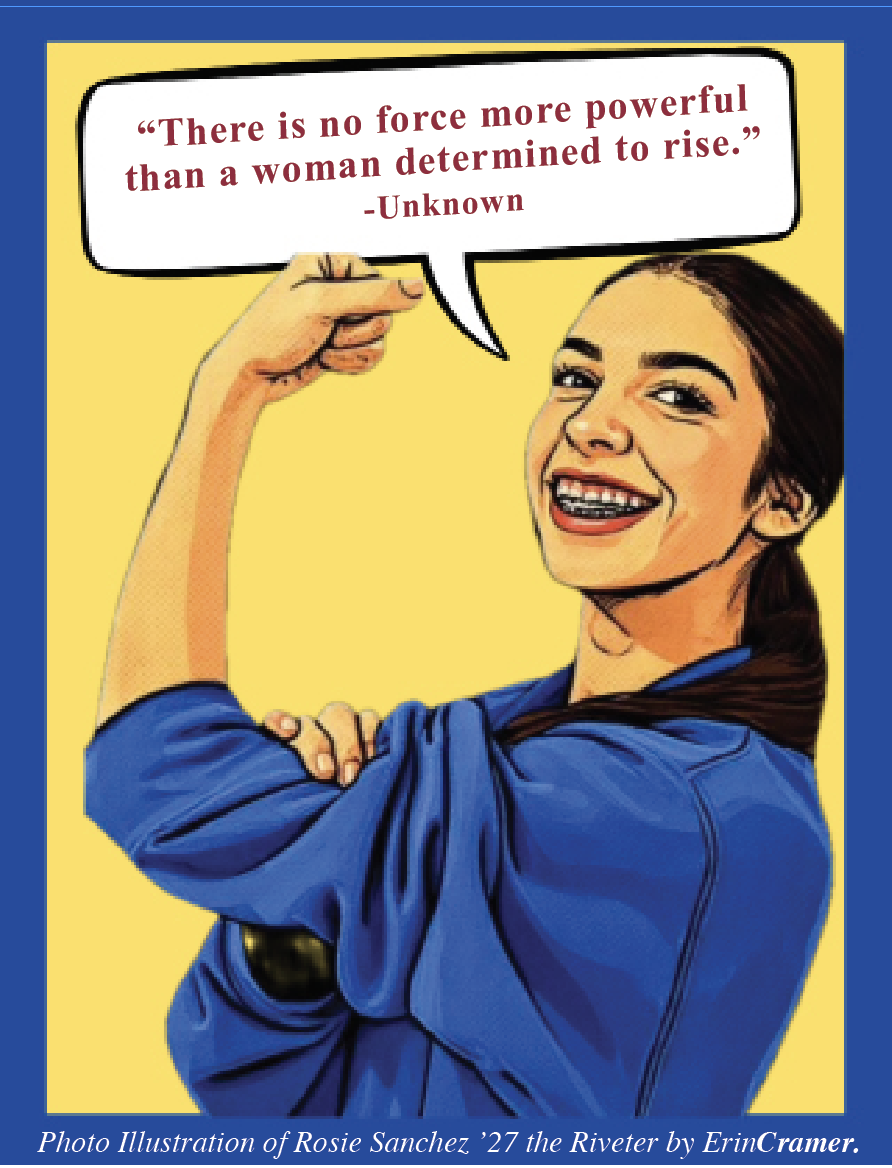
Commentary by ErinCramer
As painful as it is to admit, almost every young girl has heard someone say something that made her turn her head and think, ‘‘Wow. I don’t even know how to respond to that.’’ Whether it is a distant family member or a friend of a friend, she shudders and hopes someone changes the subject. And so she stays silent, letting it go and unknowingly affirming inappropriate behavior.
Especially within the confines of an empowering space like Marian, it doesn’t seem possible that there are people out there who make comments like these on a regular basis. Yet, across the country, a phenomenon has begun where young girls keep quiet in the face of mistreatment.
The “Chill Girl” is a stereotypical identity that develops when the young male population begins to lean further one way on the political spectrum. As of late, young women across the nation have begun to notice that young men are more emboldened to make offhanded comments, in an attempt to garner a reaction or make a joke. But it’s anything but funny.
In fear of “not being able to take a joke” or being “annoying,” young women remain silent while others laugh about insensitive and offensive comments. This is how she earns the title, “Chill Girl,” by adopting this so-called “chill” composure in response to constant inappropriate and insulting comments. According to a 2024 Pew Research Center study, 45% of girls feel a pressure to fit in socially, which often results in the belief that having a voice equals exclusion.

Marian’s Women’s Studies teacher, Ms. Susie Sisson, said that “the chill girl is a young person. And I think that young people desperately want to belong and fit in.”
This phenomenon becomes especially prevalent when the behavior is validated and justified by popular figures and the responses of peers. Therefore, when disrespectful behavior is modeled by those in a position of power, it is seen as acceptable to perpetuate this exact behavior. From this, a vicious cycle is born where outspoken (and incorrect) opinions drown out those who might speak up and reaffirms when girls are told to sit and take it.
“I think leadership sets the tone. If a public figure is making sexist jokes or behaving in a certain way, that gives permission for everyone else to behave accordingly,” Sisson said.
The idea of submissiveness of women is not a particularly new concept, however. The belief of “true womanhood” dates back to Biblical times, but most noticeably appearing in the 19th century, with an ideology deemed the “Cult of Domesticity.” In this, four pillars upheld the definition of a true woman: Piety, Purity, Domesticity and Submissiveness. These qualities justified the inferiority of women and their inherent place in the household. This concept is reemerging in the form of the Chill Girl. AP US History teacher, Mrs. Jillian Rogers, covers the Cult of Domesticity in her class.
“There’s historical attitudes towardswomen dating back to the 19th century that prescribed women were supposed to be pious, pure, domestic and submissive. And that last piece is now rearing its ugly head,” Roger said. “Women have been fighting against those standards and literally putting their lives on the line to have a voice in society and to regress to before that is more than sad, it’s enraging.” History has seen waves upon waves of feminism, each time bringing a harsh backlash from society.
“History is cyclical. What we know about women’s progress is that anytime women start to get power, there is pushback,” said Sisson. “In our current day, we’re seeing women becoming powerful again. And now, we are getting this pushback on it and pressured into returning to the domestic and submissive sphere.”
We have been lucky enough to see women in our time flourish, from the first female vice president to an upsurge in viewership for women’s sports across the globe. However, with pushing boundaries comes pushing back.
“We’re seeing calls for traditional domesticity and submission again in the age that students are coming up in, and I think that’s terrifying that this will be normalized for your generation,” Roger said.
While Marian girls can have peace of mind knowing that they attend a school with the goal of empowering them to be all they want in life, everyone can still expect in one way or another to hear bigoted and narrow-minded words. According to the Network’s November Google survey with 155 student responders, a staggering 85% of Marian students have stayed silent in fear of being perceived as annoying.
Our generation is faced with the task of not forgetting all the progress we have made and that it wasn’t all for nothing. Choose not to forget those who fought for your right to be an equal member of society by speaking up and using your voice.
According to Roger, “If you get far enough removed from oppression, you forget why it’s important.”
Empowerment is not only a core value of Marian, but a core value of life. When you walk out of Marian’s doors for the last time, you should take pride in the fact that you are empowered to make a change in the world, whether that be as a mother or as a President. No man would ever tolerate the treatment that women face, so why should we girls?
In a society full of others telling girls to “pick your battles,” stand up against those and have courage of conviction. You hold more power than you thought possible, and all of it rests in your voice. Don’t waste it by being “chill.”





Leave a Reply to EUGENE J ROBERTSON& LINDA D ROBERTSON J ROBERTSONCancel reply