
MaeleeSmith
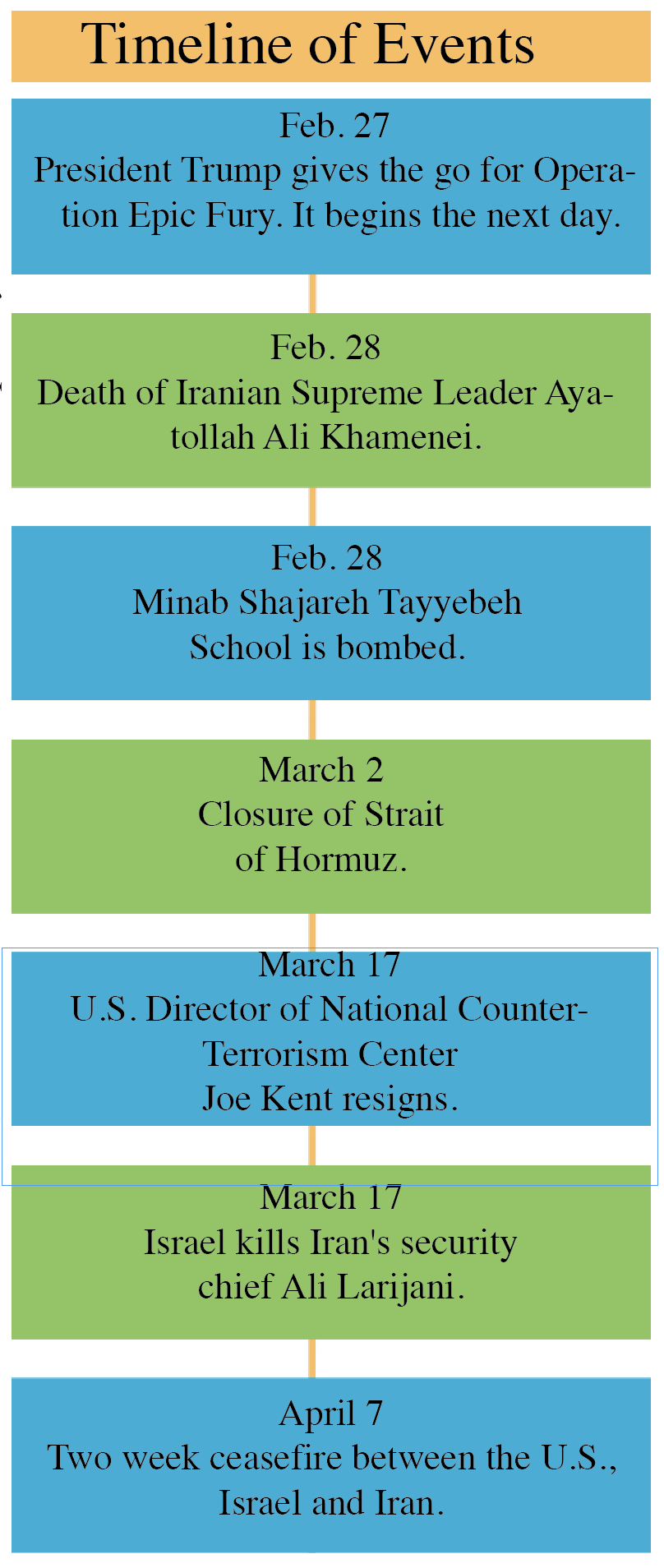
On Feb. 28, the United States and Israel initiated Operation Epic Fury, a series of bombings on Iran that lasted nearly 12 hours. The attacks were targeted at Iranian military bases and some of Iran’s political leaders, such as Supreme Leader Ayatollah Ali Khamenei, leading to his death and the takeover of power by his son, Mojtaba Khamenei.
The U.S. government has stated at war.gov, the U.S. Department of War, that the reason for these attacks is that Iran was believed to be on the brink of a nuclear breakthrough, making it an imminent threat to the U.S. In June of 2025, the U.S. and Israel, allies due to their similar military and democratic interests regarding the Middle East, destroyed Iranian nuclear facilities, despite the fact that there was no evidence of weaponization happening there. The recent attacks have been to destroy what is said to be a rebuilding of what was demolished in June. However, according to some sources like armscontrol.org, there has been no concrete evidence to prove this.
The legality of the war also remains questionable due to the fact that Congress was not consulted in the decision to attack. According to the War Powers Act passed in 1973, the president does not have the authority to declare war rather, that decision must be made by Congress, which could make the current war with Iran illegal.
U.S. Government and Politics teacher Ms. Susie Sisson tries to keep up to date with current events in the world by reading newspapers and listening to podcasts. She has been following along with the events of the war as they unfold.
“The speed with which all of this happened and the fact that it happened without any communication with the American people surprised me,” Sisson said.
During Operation Epic Fury, a U.S. airstrike hit the Shajareh Tayyebeh School for Girls in Minab, killing more than 175 people, most of whom were young girls. This caused an uproar among many people, who felt that this was a careless attack that led to unnecessary casualties.
“That school was located next to a facility that was a legitimate target. It seems to me that somebody made a mistake that shouldn’t have been made. That worries me. It makes me wonder if maybe decisions are being made too hastily,” Sisson said.
Regarding the attacks, there have been mixed emotions from Iranians. ABC reports that some feel that these attacks will help bring necessary change to the Iranian government and celebrated the death of Khamenei, while others fear for their safety and livelihood.
Science teacher Matt Winterboer is a former member of the U.S. Navy. According to him, the Navy has been involved in this conflict using submarines, surface ships and aircraft carriers.
“One of our U.S. Navy submarines launched an underwater torpedo and sank an Iranian ship, which is the first time we’ve ever sunk a ship with a torpedo since World War II,” Winterboer said.
After the torpedo attack on March 4, Iran closed the Strait of Hormuz, one of the biggest oil corridors in the world. Gas prices in the U.S. have already significantly increased because of this, nearing $4 per gallon.
”I think it’s a war that could possibly have long-term implications. That part of [Iran] is tied so closely to where we get our energy supplies from. Economically, our country is tied to that part of the world,” Sisson said.

CNN reports that the death of Ayatollah Ali Khamenei is not the only significant change in leadership that has happened during the conflict. On March 17, Iran’s Security Chief Ali Larijani was killed during an Israeli air strike attack. Also, the U.S. Director of the National Counterterrorism Center Joe Kent resigned from his position, claiming that “Iran posed no imminent threat to our nation, and it is clear that we started this war due to pressure from Israel,” according to his letter of resignation.
According to Sisson, President Trump said that the war might last four or five weeks, and it has been six already.
“It’s such an expensive endeavor, and I think we just need to take that seriously,” Sisson said.
However, as of April 7, the U.S. and Iran have agreed to a two-week ceasefire. Part of the deal is that Iran will reopen the Strait of Hormuz, but as of April 9, no ships had passed through yet.
This does not mean that the conflict is over, though. Since the ceasefire, CNN reports that there have been Israeli attacks in Lebanon, which then caused Iran to blame the U.S. for not upholding their end of the bargain due to an attack by their ally. Israel argues that Lebanon was not part of the ceasefire deal, so they don’t believe they are in violation.
The acceleration of this conflict shocked many, leading to questioning of the necessity and legality of it. The effects of the attacks have already been significant and as the conflict continues, there are sure to be more.




Leave a Reply