
ReillyO’Brien
When math teacher Miss Megan Han was a freshman at Marian, the Field Day rule book was a lot different than what it is today. Han’s class is allegedly responsible for the creation of one very important rule: “No live animals of any kind.”
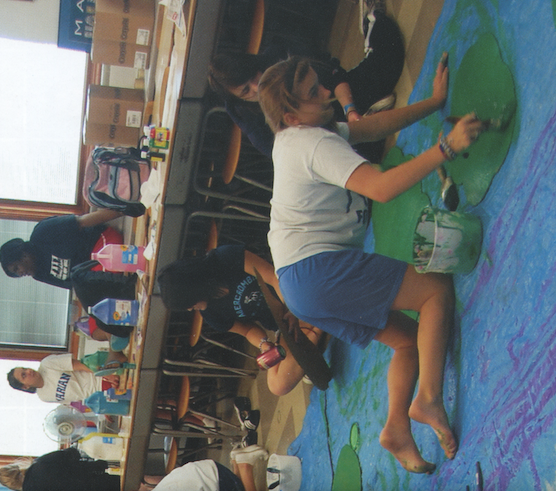
In 2010, Han was a freshman on the Walls planning committee. “Our theme was Fresh Fairy Tale, and our Walls were a forest scene leading up to a castle in the final box,” Han said.
During the planning process, the committee brainstormed ideas for things that might be found in a forest. Creating a fish pond seemed like the most obvious choice.
“We were like ‘what if we had a fish pond in the forest’ so we got a baby pool, dressed it up to look like a pond, and put live fish in it,” Han said.
What seemed like a simple, fun, never seen before idea was a nightmare for English teacher Mrs. Megan Gillespie, who was the moderator of Student Board at the time.
With so much going on the Tuesday night of Walls, Gillespie was worried about the thousands of people lining up outside the building to walk through the gym and admire the hard work.
The gym had completed its transformation and was finally clean and ready for judges and guests. Gillespie came downstairs and was listening to the judges do their walkthrough.
“I was kind of eavesdropping and walking around, and I heard one of the judges going, ‘Oh well, that’s interesting, live fish’ and I was just like, ‘I’m sorry, fish?!’” Gillespie said.
Trying to be inconspicuous, Gillespie wandered over to the freshman Walls to see what the judge was talking about. Lo and behold, there was a kiddie pool filled with water, and of course, teeny tiny live fish.
Once families started filling in, the story got morbid. Gillespie said she was quietly walking around and monitoring things when she heard the sound of a small child crying.

“I was like, ‘oh gosh, why would there be a child crying,’ so I got over there and I overheard the mom saying, ‘you know, it’s okay, sometimes fish die’ and I just froze,” Gillespie said.
Once again, she swung by the freshman walls only to see a fairytale gone wrong; the pool was full of dead fish.
Gillespie was shocked. “I wondered where the Walls moderators were when this decision was made. I mean, live fish?! Who does that?” Gillespie asked. “It may have come out of my mouth,” Han said.
After Walls night was over and everyone was cleared out of the gym, Gillespie had to add “fish undertaker” to her list of tasks. “Of course no one wanted to touch the dead fish, so I had a spoon and a cup and I scooped out the corpses,” Gillespie said.
“The next year there was a note written in the rule book, no live animals, which I think is fair,” Han said. Han’s class got third place in Walls that year, so maybe it was a risk well taken.
Another rule that Han remembers being added from her time at Marian is the one barring students from taking any souvenirs from the walls.
“It wasn’t my class’ fault, but another class had taken the characters from their walls that represented us, and did some very not nice things to them,” Han said.
Theology teacher Mr. Mark Koesters was the Student Board moderator for a few years in the early ‘90s. He remembers the reason behind a few rules. The most notable would have to be the reason behind the tug of war.
“It was either 1993 or 1994, we were having a big lunch together while they were tabulating the scores,” Koesters said. “The principal came to me and said, ‘It’s tied between the juniors and seniors. What should we do?’”
Koesters said they would have to give it as a tie. From that year on, the tug of war was instituted as the tiebreaker.
English teacher Ms. Susie Sisson was the Student Board moderator after Koesters. She held the position for 14 years until Gillespie picked it up from her. Sisson has the answer to the question of no glitter.
Years ago, there was a class with the theme Junior Geraniums. “They had a costume that allowed them to transform in the middle of their demo into a flower,” Sisson said.
“At the end of their Demonstration, they threw glitter into the air. In my memory, it was handfuls of glitter, and at the end of Field Day, all the Student Board girls and I had to clean up all the glitter,” Sisson said.
From that point on, there was no glitter allowed in Field Day activities.

Besides the rules book, there are still some funny Field Day misadventures to be told. Like in 2004, when disaster struck for the senior class. “They were the Senior Moos. Their costumes were milk cartoons made out of cardboard that came up and covered their head,” Koesters said.
The Senior Moos had never practiced their demonstration with the costumes on. “They couldn’t see or hear each other, the demo was complete chaos, it was hilarious, and of course they didn’t win,” Koesters said.
It was Gillespie’s first year at Marian, so she remembers the incident clearly. “They marched down the hill so excited. Then they started singing and it just went south right out the gate,” Gillespie said. “I looked around and I asked, ‘they aren’t supposed to be singing in a round, are they?’”
Field Day is all about taking risks, whether it’s Miss Han “allegedly” suggesting to put live animals in their walls or the seniors covering their ears and eyes with cardboard.
Marian would not be Marian without Field Day, so take some risks and make some new rules (without giving anyone a heart attack on Walls night).




Leave a Reply