
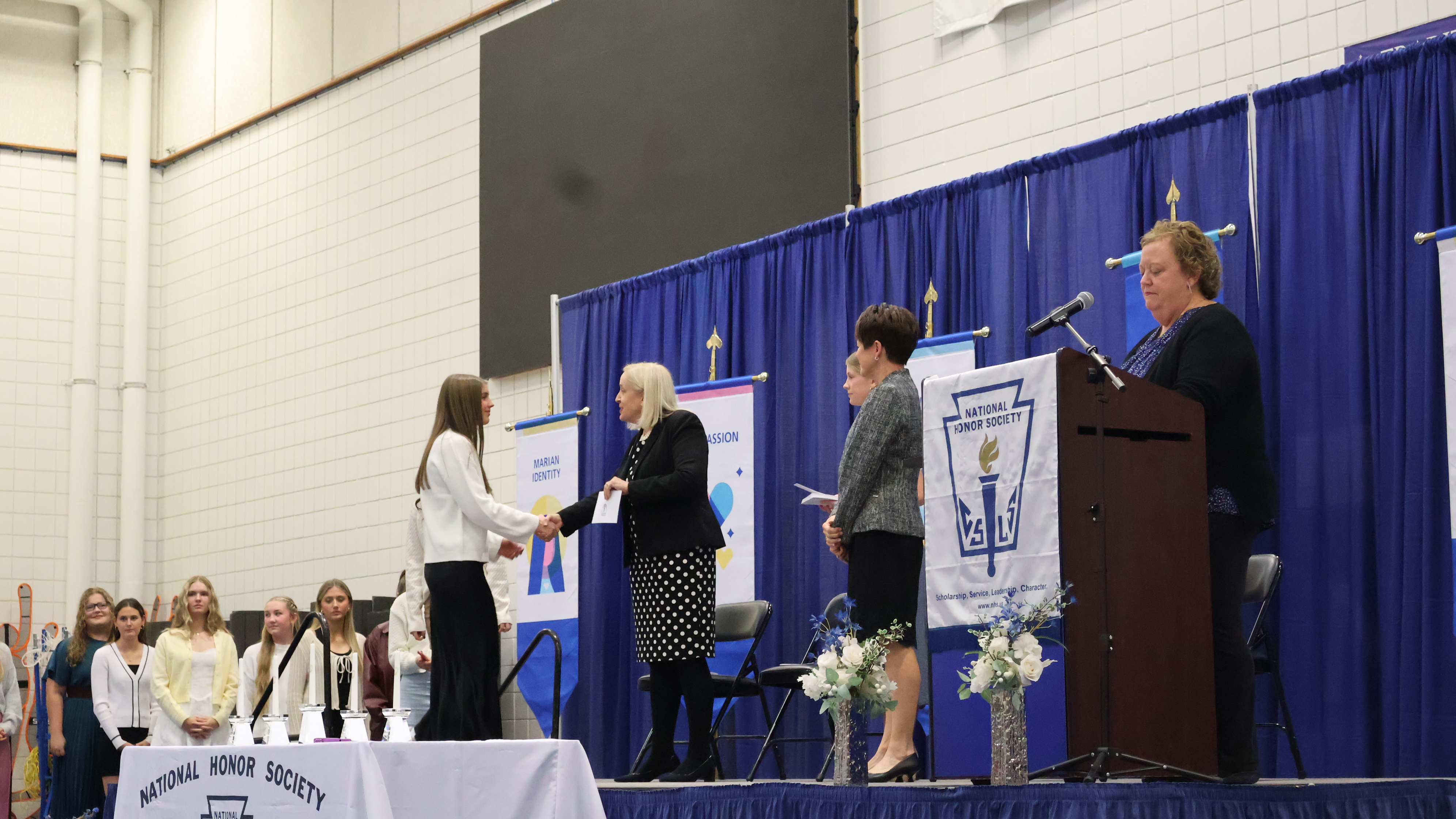
By J1 Reporter Anna Rainbolt
Marian has many students enrolled in honors classes, and with that comes many honor societies.
Honor Societies are groups of students who meet certain requirements to get into an elite club of sorts.
There are different types of societies for each subject, each with its own different set of requirements.
There are nine honor societies at Marian, the most common one being National Honor Society, or NHS. Marian also has Mu Alpha Theta, or the math honor society, National Speech and Debate Association, National French Honor Society, National Spanish Honor Society, Science Honor Society, Rho Kappa, which is the social studies honor society, National English Honor Society, and the Quill and Scroll International Honor Society for high school journalism students.
Counselor Mrs. Amanda Losee is a moderator for National Honor Society, and she said it’s “kind of like the big umbrella of national honor societies.”
NHS looks for four traits, which they call their four pillars. These include academics, leadership, service, and character. “We have to prove that all of our students who are part of National Honor Society meet those four pillars,” Losee said. To do that, Marian requires students to have a 3.8 cumulative GPA by the end of your sophomore or junior year, you need a leadership position, 20 hours of Marian involvement, and 15 hours of community service outside of Marian. Most other schools in Omaha require a 3.5 GPA, but “We have a 3.8 because it matches with our honors for graduation.” Even with that GPA bump, Marian still has about 80-85% of its students in NHS.

With more specific honor societies, like National English Honor Society, or NEHS, students have different requirements. Ms. Susie Sisson is the head of the English department, and in charge of NEHS. Students are invited to join the National English Honor Society in the second semester of their junior year. Sisson is in charge of inviting people to NEHS, “I just go through and identify the people who qualify, and then I send an invitation out to them and I ask them to fill out a really simple application,” Sisson said. To get invited, students must “have five semesters of a grade of 93 or higher in their English classes,” Sisson said.
Once students get into the National Honor Society, they are required to do some sort of service. “In the past we’ve done tutoring…We’ve done bell ringing for the Salvation Army,” Losee said. Members of the National Honor Society have a meeting where senior officers decide what kind of service they are going to do for the year. They pick a day in each semester to dedicate some time for community service. Though there are some requirements, “it’s not a huge time commitment, at least to be in NHS,” Losee said.
For other honor societies, the involvement and service is a little more specific. “We run the Marcella Writing Center, which is kind of a tutoring service for students to get help on writing,” Sisson said. Once members in NEHS, seniors run the Writing Center in the first quarter to the third, and juniors run it in the fourth quarter. Students are welcome to come to the Marcella Writing Center to ask questions about their writing, whether it is proofreading an essay, getting help on NoRedInk, or weekly vocab.
“It’s a national organization, so it’s recognized by schools.”
Counselor Amanda Losee said
One big draw to the National Honor Society and honor societies as a whole is how it looks on your college resume. “It says, ‘Hey, overall, I have these four pillars.’ It’s a national organization, so it’s recognized by schools.” Despite this, involvement in honor societies is not uncommon, so it doesn’t push your application over the edge. “It’s not going to be like the thing that really just stands out on your resume,” Losee said. However, it is still worth adding to your resume because it shows that you are a good student and it opens up scholarship opportunities. “Some scholarships are only offered to people who are in NHS.”
In National English Honor Society, Sisson believes that “Colleges recognize it as this is a student who is really good at English and probably likes English.” Specific honor societies help to focus your application and show what you like and what you are good at.
Honor societies can make you feel good about yourself, but if you aren’t in it, it’s nothing to stress about. “Do I think it’s like the end-all-be-all of it? No, I don’t,” Losee said. “It does help us feel a little bit more valid.” It’s not going to make or break your college application, but it does help when colleges can see that you are taking hard classes and trying to be a part of your community. It shows that you care about school and that you want to do well. However, as Losee reminds us, it’s not going to be a deal-breaker for your college application.
Honor societies are a great way to pursue what you are interested in and to meet more people who are interested in the same thing that you are.


Leave a Reply