

By J1 Reporter Marielle Kolterman
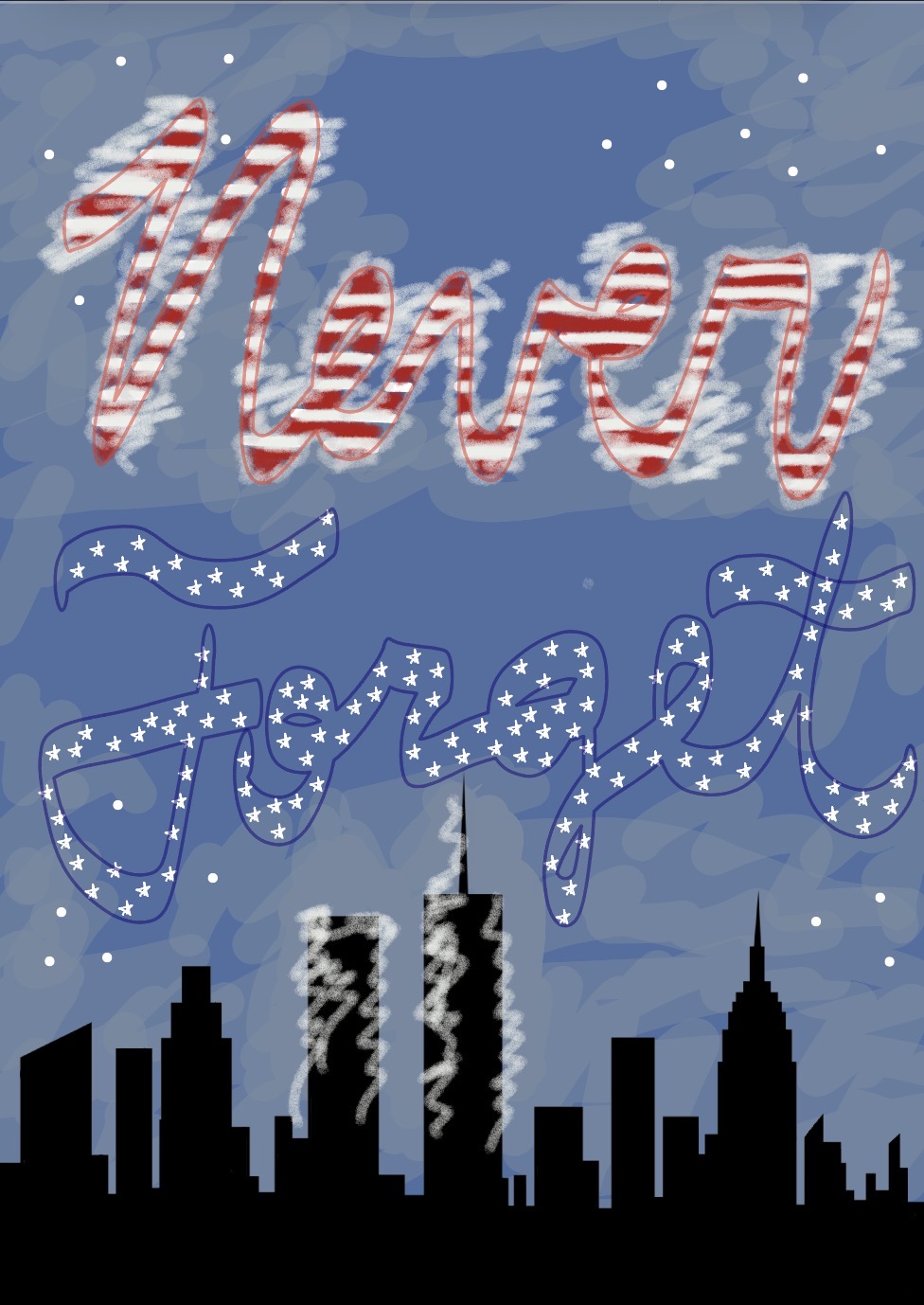
Many people hear about the tragedies that took place on Sept. 11, 2001. They hear about the hundreds of deaths that resulted from the chaos of the suicide attacks. Americans learn about the cost of rebuilding, and the new safety protocols put into place because of the disaster. Oftentimes however, it is forgotten that this day is more than just statistics. Each one of those deaths was once a life. Each person was a son or daughter. Some were brothers and sisters or mothers and fathers. Too often, those stories are forgotten, and the people dismiss just how impactful this event was to so many.
Bryan King, who was 22 at the time of 9/11, was present in New York City during the attacks. He “had just graduated from college in May of 2001.” He got a job as a financier in New York and so he moved in July. “I lived downtown in a neighborhood called Battery Park. Which is right by where the World Trade Centers were,” King said. “My building was right along the Hudson River. So, on the west side of lower Manhattan… From my apartment, you could see the World Trade Center from my window.”
Attempting to explain a time before 9/11 King said, “I guess it’s hard to describe. I mean I say it felt normal, but it felt normal to me then. Like, you certainly didn’t think anything terrible was going to happen, like it did.”
King “spent most of his summer in New York in training and learning about the job… It was great,” he said. “New York is a really fun town and there’s always a lot going on.” King said he certainly did not expect tragedy to strike, but he was there to witness it all happen.
He recalls just a week prior to the disaster, “The Thursday before 9/11…A bunch of friends of mine from work. We actually went to the restaurant on the top floor… It was called Windows on the World.” King just remembers thinking, “man this is really high. I mean you felt like you were in space.”
“And to think that that following Tuesday, is when it all played out… It was just unreal,” he said.
Exactly five days after King ate dinner on the 107th floor, the building came crashing down. “It was a Tuesday morning,” he remembers. “I walked out of my building. I was listening to really loud music in my headphones, and I could hear the roar of a jet… I took off my headphones… looked up and from the left side of my field of vision, I saw the airplane appear from the left and just plow straight into the building. So I actually watched it happen: the first plane. It was surreal.”
Several reports from that day include the confusion after the first plane hit. People were praying about the freak accident, and didn’t realize that it was an attack until the second plane hit. King’s report was a little different.“As soon as it happened,” he said. “I knew it wasn’t an accident… It didn’t look like a plane that was crashing. It was flying straight and flew straight into the building… It kind of disappeared into the World Trade Center. Those buildings were so massive,” King said.
The plane ripped a hole through the thick layers of steel, leaving offices exposed to the wind. “There was smoke coming out of the tower, and you could see lots of papers fluttering down from the hole in the North tower.”
King heard the impact of this moment before he understood it. The silence that fell over New York was much louder than the explosion it followed. “It was eerily quiet,” King continues. “And then this woman next to me just started screaming and crying. And then in the distance you could start to hear sirens.”
Immediately after the impact of this event was realized by King, he picked up his phone to call his mom.
Aside from the crashes themselves, one of the scariest parts of this life-altering event was the lack of communication. Several reports stressed the anxiety of not being able to reach a loved one who was near one of the sites. “The cell phone coverage completely collapsed after the towers collapsed… I believe that there was a lot of telecom equipment on top of the towers and so when they were completely destroyed, it wiped out lots of cell coverage on the island,” King explains. In addition, “the cell coverage was just completely overwhelmed with people trying to get a hold of family or emergency workers.”
Before the collapse of the first tower, he called his mother, the connection not having been severed yet. He said to her “Hey, you gotta turn on the TV. Something awful happened. I’m here. I’m okay. Just watch the news.”
After that first call, King couldn’t reach anyone for more than a day. When the coverage finally came back, his phone was overwhelmed with missed calls and messages from friends and family members trying to find out if he was okay.
Following his phone call to his mother, he just “kept walking…I walked across the Westside highway, which is the big road from North to South. You could already see the fire engines speeding down the highway to get to the World Trade Center.”
King made his way to the front of a school at the corner of Greenwich and Chambers. “When the second plane hit, I was pretty close to the towers. So, we couldn’t actually see that there was a second airplane that had hit, but we saw a big explosion over our heads… I remember standing out in front of a school. There were all these little kids and their parents. And when the second explosion happened, the parents just started picking up kids, throwing them over their shoulders and just started running north.” Everyone was “trying to get as far away from the towers as they could get.”
King was not unlike everyone else in this way. After the second tower collapsed, he left his area and fled north. Due to the proximity of Battery Park to the World Trade Center, his apartment was prohibited from entry. He squeezed into a college friend’s apartment in West Village for several days. For the duration of his time there, he and his friends sat in front of the television. He remembers that all of “America woke up and started watching the news.” It was a very draining time. “The news was unrelenting,” King explains. People were in a state of panic that the country was going to war or that bombings or other attacks would start. Although it was important to stay vigilant of updates, he thinks back, it was also so bad for general mental health to hear the constant doom coming out of the television. Sometimes, terrible things can spiral and cause so many other horrible events to happen. After the events on Sept. 11 however, America came together more united than ever. Immediately after the attacks, “our country was extremely patriotic.” King says he remembers feeling a “pervasive sense of unity” coming from himself and everyone around him. It was the day the U.S. became us.
“I got a call from a wrong number one day,” he says. “A man with a thick accent answered the phone claiming he had dialed the wrong number and said, ‘Oh, I’m sorry, brother. We’re all brothers now. We all gotta stick together and fight back.’” That simple phone call King says was “emblematic of the way that people were dealing with it.” People all around America became a united front against the terrorists that perpetrated the attacks as well as the Afghanistan government for sheltering the terrorists who were behind the attacks on 9/11. The “National consensus,” King says, justified a war against Afghanistan. Things changed later as time went on, but the attacks really fired the people up to defend their country, which led to tensions throughout the globe.
In addition, the speech at Ground Zero from President George W. Bush and his “first pitch at the Yankees game” King says were examples of the people trying to return to normal.
Sept. 11 killed so many, and permanently changed the lives of an even greater number of people. Even if an American thinks that they are not affected by the attacks on 9/11, they are. Many changes were made, and King says the biggest change he saw was the fear. In an attempt to dampen those fears of the American population, “there were a lot of security measures that were introduced. Not just at the airports, but everywhere. Eevery tall building in New York had security, metal detectors, x-ray machines, and it was a real shift.” The government implemented many different kinds of safety measures to ensure that a tragedy such as this would never come again.
Many governments outside of the United States also implemented safety measures, scarred by the damage done on Sept. 11. International victims were also killed in these attacks, so although it was on American soil, the collapse was felt world wide.
Americans continue to learn about this day; the horrors, the afteraffects, and also the hope. It is important to learn and keep teaching about 9/11. “It is a pivotal point in American history,” King said. Everything in the past 25 years in both America’s domestic and international affairs has been influenced and changed by this event. To deeply understand the world today, it is essential to learn of the events of 9/11, and keep the people, through their stories alive.
Bryan King, thank you for sharing your story.
Thank you to all who continue to share the stories of those left behind.


Leave a Reply